I’m experimenting with a new media but with the same goal of giving you something to help. I’m a little addicted to it I admit this week while traveling. So two for you today.
3 Powerful Words and How to Avoid Sales Pain in the Shower. How can you resist?
If they help you grow your business even a little bit, that would be (as we say where I’m from), wicked awesome! Have a great day!
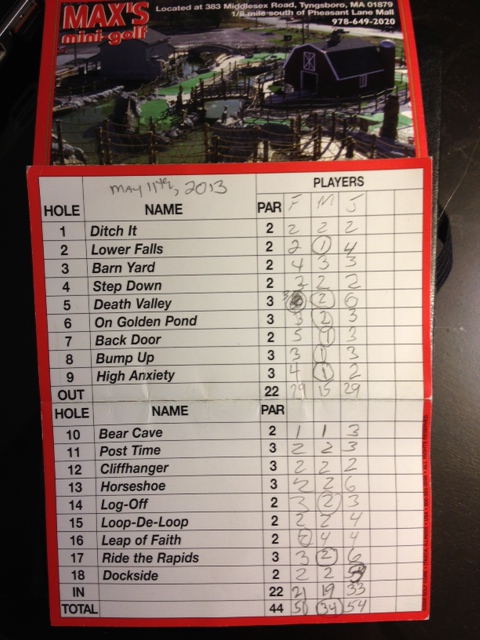
I took great joy in beating the two 16 year olds Saturday. Crushed their souls I did.
But I took greater joy in beating up the golf course. 10 under par was my score – that had to be some kind of record!
At least for me it was. I am framing that pictured scorecard and it is going right downstairs in the Man Room on the wall where it belongs.
10 under! Some team of golf course architects sat in some design laboratory in Florida years ago when they designed this course figuring out that the hole called “Cliffhanger” was a par 3 and that so was “High Anxiety” and so was that monster hole “Bear Cave”. Heck, the Masters has names for their golf holes like “Magnolia” and “Golden Bell” and that is one tough course.
But these golf course gurus did not expect my 5 holes in one Saturday (including 4 in a row!) and nor did my son and his friend. “Go build your fragile self esteem and confidence somewhere else” I said, (like I literally did say that). I was on fire!
I knew my concentration and skill were better than the two teenagers and that I would win, but the best part was I was way better than the “standard” of good golf – by shooting a 34 on a par 44 mini-golf course. Expert mini golfer in the house! I’m a darn near pro! I will always have good feelings about Max’s Mini Golf.
Now when you think about it, par 44 is probably a bit liberal assessment of the course difficulty. And probably on purpose by said architects in my vision. But it made my day. Quenched my competitive spirit it did. It really did. Silly I know. But not really. There’s something about it that’s good. And smart.
I wonder if that “better than standard” thing has some value in the workplace and in business. – Actually, I know it does:
It’s the crux of the silver, gold and platinum airline classes as well as the credit cards. Everyone knows “most people” aren’t or don’t perform at these levels so already that kind of “achievement” and expertise ( think all the “professional traveler” commercials you see of late) taps into the emotional competitive attachment of individuals and to that of the company.
Gamification is huge in the world of learning today. In some businesses you log into “game portals” – play games (and learn), earn points, badges and medals advancing through levels and certifications of expertise. You know all the way along how you compare to “standards” and your peers ( where you rank) in oodles of categories. On purpose.
Pizza joints love the “Beat the Pizza-mageddon” where in the space of an hour two people must eat a pizza the size of a man-hole cover and win prizes and publicity in the local paper. “Nobody’s done it yet” the sign says. That’ll drive more than just 2 adults to dare- they’ll bring all their friends too and order up! Bring your competitive spirit and your emotional attachment to the joint like, forever.
So fun is good. Winning is good. Earning stuff is good. But having the chance to walk around town as the perceived professional mini golfer, the professional traveler, or even the pro eater is well, good for business too.
Nobel Prize winning Psychologist Daniel Kahneman said “The remarkable thing about your mental life is that you are rarely ever stumped.”
How interesting. This little quote has roiled around in my head for a month. Can’t shake it.
Think about how true it is. Heck, I’m gonna do this or I’m gonna do that. Or goshdarnit, I’m going to do nothing! Bottom line is most of the time, I know what I’m gonna do. And most of the time we make judgements and decisions in a flash and rarely are stumped or stuck in a quandary.
I read Kahneman’s quote in the Heath Brothers latest book called “Decisive” ( big thumbs up from me). The book has some compelling methods to help us all make better decisions of course ( if we ever allow ourselves to be stumped) but that’s for a later blog or two.
Lets just chat a bit about the stumped thing. Stumped is what I think we should be more of. Here’s why:
When was the last time you talked to a prospect, did some great discovery, built credibility and commonality, talked pain points and said, ” You know, you’ve given me some things to think about and I’m not sure exactly what the best thing to do is, let me get back to you in a couple of days.” Answer? Never. You’re in sales, you’re never stumped and you and I both know it.
When was the last time you launched a project to tackle a problem and didn’t pretty much have the answer already embalzoned in your brain about what you think is the right solution? Way less than you think. You’re not stumped. No Never. Not you. You can, like nobody else, see the future clearly.
When was the last time you didn’t judge, label or categorize someone you just met because you were so comfortable with “waiting and seeing” what this person was really about? Not often enough. You’re never stumped when it comes to giving an opinion on the new person even if you just give that opinion to yourself.
The you here is me ( and yes, likely you too).
I’ve pitched an idea or a solution well before I knew what I should really do – I should have been stumped. I’ve launched a project ( just this week as a matter of fact) tackling a problem that I am brazen enough to think I already know the answer to, until my LEAN mentor smacked me upside the head and said “You need to be stumped in the beginning for this thing to work.” I’ve judged someone in just 20 minutes of conversation and another in probably 30 seconds – and did it not long ago either – both are awful things to do. Not fair and frankly, stupid. Stumped is what I needed to be there and always.
Not being stumped can get us into trouble; that’s the message here. Conversely, being stumped can do some great things like impress the hell out of a customer and get them the best help possible. Being stumped can get your problem solved better because you didn’t presume you knew the damn answer. And being stumped is certainly the best way to treat people you meet all the time and to get the most and the best out of that relationship.
Stumped ain’t bad. Stumped is good. So all you people out there with the answers ( and that means you too McCarthy) quit talking to me, I gotta work these things out like I don’t have any idea.
Who knew Billy Joel could teach us a key lesson about sales and marketing?
Lately I’ve been really into Billy Joel again. Not the late 80’s and 90’s Billy – Uptown Girl stuff, but the good stuff – The early stuff.
My son (who is downright amazing on the piano), was on YouTube last month and watched the Inside the Actor’s Guild 1999 Interview with Billy Joel. I (a piano player of a lower order) decided to check out that interview too.
And then I heard him say it. It was stunning.
“Piano Man is really not a good song”. He said this in reaction to James Lipton pointing out one of the most unusual things about the song – that it was in ¾ time. It’s essentially a waltz.
It’s a waltz but that’s not why the song is “not that good” Billy explained. He said that the song is “so simple” and really just “repeats itself over and over again like a Limerick” with even some “La da diddy da’s” thrown in.
He said some people know it’s bad. Whenever he enters a restaurant or bar with a piano player these days, the musician will make eye contact and invariably start playing “Piano Man” which is all nice and good until “he realizes the song just repeats itself” and then “repeats itself some more” and “then he looks me in the eye blankly and I just nod and say “See? Not much too it!”
I love that song. We all love that song. It’s a great song!
“If it’s so simple and bad, why is it so popular?” James Lipton asked.
“It’s got one hell of a story” Billy replied.
There is was. And there it is. There’s Paul – who’s a real estate novelist, there’s Davy who is still in the Navy and there’s the waitress who is practicing politics. All real people Billy explained (even Davy whose name is “Davy” and was in the Navy.)
The point is pretty clear. Great story makes up for a lot of things. Some of Billy’s music is compositionally brilliant and has good to great stories in them; New York State of Mind and Scenes from an Italian Restaurant come to mind.
But Piano Man is not a great song. It is simple. It does sound like Limerick. But the story. The Story. The Story. That makes it good. And makes it stick and well, makes it awesome.
You need stories. We all need them. Piano Man is a lesson about how a great story needs to be wrapped inside your business, your solutions, your brand and your pitches.
We know this. We hear it all the time. But we don’t always listen. Powerful stories work hard for movies, books, businesses and I realize, music. So all you marketers and sales people get out there and sing us that song, you’re the Piano Man!
How many of you like pulling VM from friends or colleagues on your smart phones, home phones or work phones these days?
That many.
I thought so.
So cumbersome, this voice thing: So much time wasted listening to the slog of a human voice blathering dozens of extra words around the likely simple intent of the message added to the process of accessing, listening and remembering what was said ( or worse –lunging for a post it note to scribble it on).
It’s getting harder and harder to find the time out there to listen to the human voice share information.
Why? Because it’s getting so much easier, faster and efficient to read it. And type it. And text it. And Like it. And Follow it. And also to Learn and Share and Refer and Recommend.
We are information hogs, all of us now. We can’t get enough. We want information in huge amounts, And we want it in a way we can save it, retrieve it and share it. We want so much so fast, that it becomes easier to accept the inefficiency of the human voice and not want to use it or as we more increasingly feel, hear it.
You need to understand the change here on a couple of levels.
You as a person and an employee should know:
When you do talk or leave a voicemail, it better be good and meaningful and compellingly vital because if it’s not- it should have just been an email or post and eyes will roll.
Human nature yearns for the sharing of “one to many”. Everything you might have wanted to say to some one you can say to hundreds or thousands at the same time but without the fear of Public speaking. That is outrageously attractive to people. And that’s a powerful thing for your self and your career if you embrace it well.
You as a business owner should know:
This is Word of Mouth now. This is where your clients rave or rage about you. You must make it easy for your customers to pass along good things about you and your business. One to one still works but people would much rather “tell 10 friends” except this time they can do it for real in seconds.
You have to be smarter and cooler and more valuable than your website. If talking with you takes 5 times longer than what the prospect could have gotten in 3 clicks on your website then you are not adding value where you should. Think hard about what your voice brings to your business. Think brand. Think feel. Think purpose. Then plan and speak accordingly.
When you look closely, there is no comma, slash, semi-colon, parenthesis or period between the title words “Sales Representative.” And that’s on purpose. You have to do both at the same time.
You have to sell but you have to represent the company simultaneously. It’s not one or the other. You can’t sell for selling sake and set unreal expectations or pound out fishy phone calls or phishy emails because then you are not “representing” the company well. Conversely, you can’t be all Kumbaya and go harvesting customers with super friendly experiences and never broach filling the unmet needs of the customer.
There is no comma, slash, semi-colon, parenthesis or period between the title “Service Representative” either.
You have to give great service but you have to represent the company simultaneously time. It’s not one or the other. If you don’t take ownership (“I don’t know why they did that in shipping..”) or apologize for real (“sorry that happened to you…what’s your account number?” ) you are leaving an awful impression as a Rep of the company. Conversely, your reliance on policy or procedure or terms and conditions do little to evoke the “service” part of a service call.
There is also no comma, slash, semi-colon, parenthesis or period between the titles of “Sales Manager” or “Service Manager” so you best know sales and service at an expert level and likewise need to know how to expertly support your people at the same time.
Punctuation between words has its place – a means often to stop, pause, reposition and separate. But if it ain’t there it ain’t there – that means when the words go together; they belong together.
Whether I, your prized business prospect, is calling you or picking up your phone call, there are things I just won’t tell you.
1) I used to be in sales too. You’d be surprised how many of us decision makers started out, or are still in, sales. And I can still smell a trial close, a rotating yes and min/max close from 50 feet away. Don’t use tricky closes on me.
2) Don’t make me feel stupid even for a second. I know my world very well – not your world and if you make me feel like I’m an idiot presuming I know or like your acronyms, buzzwords and fast talking pitches- I’m gone; I’ll just go to your competitors website and read and email- – that way no one has to talk to me.
3) Tell me what everyone else is doing. I hate to admit this sometimes even to myself but I do want to know what my competitors or even my industry is doing lately and haven’t had any time to dig in. But I’m not about to go ask you — yet I wouldn’t mind hearing it if you wanted to just shout it out. Am I missing out on something or some trend?
4) I know more way more about you than you think. I’ve been to your website; I’ve Googled your reviews. Heck I’ve Googled you and saw you on LinkedIn and Twitter (or didn’t- and what does that mean?) I may have seen a few opinions about your company on Twitter already. So don’t waste my time with the basics about yourself – I got it. I called you because I want something more than the internet can give me.
5) I don’t expect much from you. I just never know if you really work for this company I am calling or am getting called from. Are you a contractor, an outsourced support, brand new employee, who knows? I don’t have high hopes but if you can assure me quickly you know what the heck you are doing then maybe I’ll listen.
6) I’d rather do nothing. Seriously, I hate change. I wish everything I do today would just work better. Change is costly, risky, takes forever it seems and I am busy enough already. I won’t tell you that of course. I’d rather just flat our say no or compare you to someone else or put you off but honestly; doing what I do today is just easier. If you can’t make me do something “different” and get me to get off the dime and essentially hate what I am doing today- then don’t bother.
7) You’re 7th on the list. I respect you dear supplier but my family, my boss, my colleagues, my customers, my pastor and my pets all come before you my trusted partner. Nothing personal- you can be very valuable to me but everyone else here is getting something for Christmas next year just so’s ya know.
Isn’t a meal more important when it is perceived to be a means towards losing weight or is it when it is consumed because you are hungry?
Isn’t a car more important when you plan on passing it on to your teenage kid or is it when you just need to get from A to B?
Isn’t a business card more important when it helps you rebrand yourself or your business or is it when you just need to leave something behind so they can reach you?
Isn’t a website more important when you need to stop the competition from stealing your customers or is it when everyone keeps saying you should have one?
It’s always the former, not that latter.
If you sell meals, cars, business cards, websites or anything else for that matter, you’ll sell more of them when you get at how those products can help a person achieve something bigger. When that happens, those products and you become more important.
Get at it. Most people and businesses are not shallow. There’s some dream, some pursuit they are after. Tie your products and services to that dream or a goal and your stuff becomes more important.
This is the year to quit being afraid. Let’s start with these 7.
Don’t fear having to memorize all your product specs and prices. What matters is you remember how the darn thing helps them do what they really want to do.
Don’t fear social media. Embrace it. More people, customers and employees talking to each other is way better than silence.
Don’t fear the so called demise of the offline marketing world. I don’t know any business that is moving totally away from it. Blend is always the key. In fact, that integrated offline/online mix might get a little more attention than it used to these days.
Don’t fear the board game. It’s OK to make eye contact with your kids now and then.
Don’t Fear the Reaper. Classic tune. Have a Listen. I heard they played at my High School way back in the early 70’s. Yup they did.
Don’t fear going back to school. In fact, everybody should be in school. If you are not dedicating to learning something new at least an hour a day at least (and I don’t mean watching or reading “news”, timelines or posts) you are behind your competitors tomorrow.
Don’t fear Neuroscience and Neuromarketing. Get into it. How you think, why you think the way you do. Why your clients and team react to things the way they do is important to know . As someone once said… “Just because it is your brain, doesn’t mean you know what it is doing”.
Don’t know if any of you fly a lot. I kind of do – at least of late. At the airport, there is one phrase gate agents of a certain airline sometimes say ( actually proclaim over the loudspeaker) that just crushes me. It’s horrid. It makes me instantly hang my head in depression. It ruins my flight, my day and my mood immediately.
“Our flight is completely full today..”
I’m not a small man; (thankfully not ready for the seatbelt extension just yet) but Lordy, when you hear that phrase, thinking about getting into and sitting in those seats and aisles built for middle schoolers, is now horrid on a grand scale.
I think there are some other horrid phrases agents of many industries say these days that can give that same kind of instant feel of dread and depression.
“OK, let’s see what they did here..”. Are you kidding me? As soon as your client with a question hears “they”, the horridness kicks in: Oh my, you are not in charge. Oh my, I’m gonna have to talk to someone else. Oh my, I’m talking to an idiot with no authority. Oh my, this place is so big, I’m never going to get the answer.
“Can I have your phone number in case we are disconnected?” It’s 2011! The only disconnections are when someone does it on purpose. Your client or prospect is in the horrid zone immediately: Oh please, you want my number to pester me at dinner or in a middle of a meeting to sell me something with your silly outbound program. Oh please, now I’m in your database and all I had was a darn question. Oh great, they have crappy phone systems with disconnect issues, can’t wait to do business with them.
“Mark”, “Mark” , “Mark” Yeah that’s right, my first name. You say my first name more than twice in a conversation on the phone or face to face and a horrid sickness overcomes me and your customers too: Oh I get it, someone trained you to use ” the customer’s first name” often in your calls- that feels genuine! Oh I get it, you are as slick a sale rep as I’ve ever seen – you make me wanna take a shower.Oh I get it, you think using my first name a lot makes us like family or brothers and I will buy your stuff- lol!
The thing about horrid phrases is the emotions they elicit have staying power. They linger. They stick. They can even leave a lasting impression about you or your company as a brand that is as uncomfortable as seat 28B.





 Mark McCarthy's Blog