
Platinum Question(s) Are Better

Standard

platinum

Longer post today, but I think worth it.   Scroll worthy for sure – maybe even print worthy.  Hang in till the end but only if you want to be more successful.    

If you are in sales or marketing, you’ve undoubtedly heard the phrase the “Golden question”.  It’s usually a crafted discovery question in which the answer tells you the sales person, whether the client or prospect is “ripe” for a sale, cross sell or upsell. 

Golden questions are fine.  Many aren’t that golden however.  [Although I do remember one from a pet supply mail order company where the agent asks the inbound caller “Are you going to get little (insert pet name here) something for Christmas this year?” and if the caller says “yes” – then release the hounds ( pardon the pun) of sales pitches, cross sells and upsells now!!!  That one wasn’t bad.]

Golden questions are fine but have drawbacks.  They usually come out of no where, reek of “Here comes the sales pitch” and have no perceived immediate value to the customer or prospect that has to answer them.   Platinum questions are much better. 

Platinum questions are a term I use for questions that give you the same valuable information as a golden question but do so in such a way that does not raise sales tension or customer fatigue in the interaction. 

In more detail … Platinum questions are presumptive discovery questions that make sense to the customer or prospect. They make sense because the answers are beneficial to them and the reason they called, stopped by or visited your site.  In addition, Platinum questions give you the seller, vital information and credibility to leverage and transition from in the sales process. 

That’s a mouthful so let’s put it to real life.  Let’s say you work in a print shop that does lots of things for a small business like a wide range of print, to designing logos, to providing websites, to offering online marketing products etc etc.

In walks a customer who wants to reorder some business cards.  Perfect.  Now, you could do what you’ve always done and say “Is everything staying the same on these on these cards?” and then (unless you feel like getting rejected) you could start pitching all of your other services.

Or you could ask a Platinum question or two.

  • “You’re ordering more business cards.. Great. Since you last ordered these have you made any changes to your website, your email address or social media sites you use for the business?”

Anything the customer answers is valuable.   Even the simple “No – nothing’s changed” (which tells you a lot) to “Um…I don’t have a website yet” to “..What social media sites do you mean?” to just asking “Why do you ask?”  are awesome answers.

And the answer to “Why do you ask?” of course is the truth – you ask because you are a pro and know that many small businesses put their website address via a QR code and all their Twitter/LinkedIn/FaceBookr logos on the business cards these days (I’ve even seen them on printed checks).  So these questions make sense to the customer as to why you are asking them – these questions are in their interest to help you get this business card order done just right.   And the answers give you amazing, as good as golden information with half the pain. 

Here’s the real beauty of the question; It’s presumptive ( “…have you made any changes?”)  – it assumes the client already has a website and uses social media generously.  You ask it like you’ve been there before and that other small businesses do this all the time.  That’s brilliant on your part because you are educating and teaching at the same time.  It also tells you in an instant; (in a way that does not sales stress or fatigue the customer) whether they even have a website (or ever thought of a QR code)  and how they feel or don’t feel about online marketing (i.e. if they use social media for business that’s a good hint they may have interest in focusing more calories there).  In so many ways, you have a painless transition point to talk about other services much more easily than by just pitching and praying.

You’re not done with Platinum questions just yet in your print shop.  Let’s go for two.   

  • “Any major changes in your business since last time you ordered business cards – any new services, products or anything?”

 “Why do you ask?”

  •  “Oh, well sometimes folks want to call it out on their business cards, or even update their logos to reflect the changes”.

Ding Ding.  You get it.  You asked a presumptive question in the interest of the client’s need to get the business cards done right. Makes perfect sense.  And you learned if you have inertia to talk about a logo refresh.

Platinum questions take some crafting- so do those supposed Golden questions.  But Platinum is soooo much better.

It doesn’t matter if you sell forklifts for a living and are moving into propane delivery services or maybe you sell commercial insurance and are branching into risk and compliance consulting – when those customers call you for maintenance or to renew policies- you’ll have crafted those Platinum questions optimizing the customers current need and setting the stage for further help and sales.

It doesn’t matter if you are in customer service or technical support and have some obligation to upsell or generate leads – crafting Platinum questions works perfectly well here too.  Those discovery questions that help the client get their problem fixed well but tell you much about them and lead to great sales conversations are doable (I know, I’ve helped craft them before). 

In the end, you don’t have to do Platinum questions and can continue to do discovery the old fashioned painful way:  ‘Do you have a website?” “Ever thought of updating your logo”?  or “Who is your current propane delivery provider?” You can do that and raise sales tension, customer fatigue and get what you’ve always got right up to through your golden years.

Or, you can spend time right now by yourself or with your team – and go Platinum. 


Till next time,

Grow The Business.

Mark


Mark’s Blog

Mark’s Twitter

Simple Remote Love

Standard

neon clock

I have a ManCave.   Yep, I do.

It has cool signage like “Eat Bacon”, “Hydrate with Beer” and has an awesome neon clock.   It also has a classic table hockey game, a framed Jaws movie poster, a nice TV and of course, the DVD Tommy Boy (the Holy Schnieke edition). 

But what I love most about the ManCave is the TV remote control.   It’s so… simple.

I don’t have a sound system like surround sound or a sound bar in the man cave.  I have just the TV/ Cable and as such, just the one remote.

What a joy to sit back thinking of bacon and barley and when I want to turn the volume up or down—I just use the remote.  The one remote.  The simple lonely silver remote that turns on the TV, the cable, changes the stations and controls the volume.

Remote controls are by their origin, the birthplace of simple 40 years ago but as you all know, they have become anything but that (don’t tell me about the “universal remotes” out there—I’ve tried those—they don’t do it all no matter what you say).

Upstairs it takes no less than 4 remotes (TV/Cable, Sound, DVD & the TV Standard (to change Input)) to manage wasting hours and hours of your life you will never get back (upstairs is where stuff like “Bridezillas” and “Sex in the City” reruns play). 

Last night in the ManCave during the Red Sox game (Go Sox!) I turned to my wife (she is permitted into the Cave with advance notice) during a commercial break and said “Don’t you love that you only have to use one remote to do everything here?”  She about jumped off the couch and said “Like you would not believe!” She continued with “It’s so simple..I love simple..”

And that’s the lesson today.   In an effort to simplify we often create confusion, frustration and stress.  It’s great to have social media sites simple to use to keep us connected but to have like 11 of them where you need a bloody presence to get through your work or personal life day is maddening.  It’s great to have smart phones glued to your hands but the chargers, the connections, the storage, the email boxes and the updates are maddening.  It’s great to have a quadrillion websites with information, education and tutorials, testimonials, ratings, opinions and pontifications but figuring out which of these quadrillion you can trust is maddening. 

Every one of us I suspect longs for something simple that just plain “works” today.   Something you can find, something you can trust, something that is simple to use and something that doesn’t make you feel like there are 7 more things just like you I have to go check out or “I’m not doing it right”.    

If you can do for a business or consumer what my remote control in the ManCave does – you’ve got a winner. 

Till next time,

Grow The Business.

Mark

Mark’s Blog

Mark’s Twitter

Tangibly Speaking

Standard

Blue Sun

Tangibly Speaking

How timely. 

The Cool factor for this ad? A 10.  And psychologically smart too. 

Kudos to the Blue Sun.  

As it happens, later today I’m presenting six effective ways to teach and coach to selling products and services that are less tangible than others.  The audience is a group of motivated sales leaders.  One of those six ways was one I didn’t expect to see in seat 19B yesterday.

As my flight was descending into Minneapolis yesterday afternoon, I was forced to shut down (ok – hide) all electronics –so I picked up the Sky Magazine to read.  I flipped through the ads for the best plastic surgeon(s?) in the world and the many lunch dating services (I would definitely need the former before I could take advantage of the latter – and um..of course, er.. not be married.), but then I fell upon on page 58.  Oh Joy! 

Here it was!  An “in print” example of working around what many sales and service people face who try and create interest in, or sell, intangible products – It was a wonderful means to get people to actually just “try it”!

The TechnoMarine ad copy says “Lift here to experience Blue Sun on your wrist”.   And there gloriously lay, a perforated cut out you could lift out and place on your wrist.   

I know what the makers of Blue Sun are thinking- that it’s one thing to read about the watch and see nice pictures but to “see” the watch on your wrist? – now, that is something.

I know a “watch” is not intangible or abstract like my training focus later today but TechnoMarine knows that selling a watch in a magazine is for all intents and purposes an “abstract” timepiece trapped in a two dimensional pixilated prison.  And what I know about selling abstract products and services also applies here in that you have to often  “try it” or “experience it” before you make a decision or even move the sales process forward. 

Pretend you are selling a financial management dashboard or a social media business portal – you have to get your clients hands on the keyboard and immersed in her screen and that dashboard a bit first –like the ubiquitous test drive.  It’s akin to having that faux paper watch wrapped around your wrist to see how it fits

What I love about the watch ad is how quickly you can experience it. Boom!  Lift it and wrap it around your wrist.  Easy Peasy.  And there is a QR code on the back and you can learn more about it.  The Blue Sun ad is like the steroid version of the “scratch and sniff” print ads.- one swipe and you’ve got the experience – but in this case you can really wear it. 

The broader point is simple too.   “Try it” opportunities that allow you to test drive products – even when those products aren’t super abstract or intangible like a watch or a new car, (pardon the pun) are key.  They always were and they always are.   In the crazy world today where we have less and less time to get our prospects attention – it’s important especially when your product or service is not crystal clear immediately, to create those opportunities when a client can “wear” it.  

Keep creating those free trial apps, the Freemiums, the virtual realities and the test drives for abstract and intangible products and services.  And if you ever get a chance to put a perforated cut out of your product in an airline magazine – do that too. 

Till next time,

Grow The Business.

Mark

Mark’s Blog

Mark’s Twitter

Got Smarter Customers? No Problem

Standard

internet

Got Smarter Customers? No Problem

If you’re in sales or marketing – over the last few years you’ve heard loud and clear some version of the phrase –

“Buyers now are now as much as 70% farther into the sales process by the time they contact a vendor because they can learn so much about your product and service online”

I don’t disagree.

But I also don’t give a hoot.  Neither should you.  

Instead of lamenting this truth – sales people need to adapt and do things differently.  Complaining that every lead you get “just wants pricing” or “already knows exactly what they want” is a sure sign things need to change.  Most important however is realizing that sales people getting involved early (and sometimes way early) in a sales process lessens the likelihood that your product or service is perceived as just another commodity.  People influence.  People persuade.  People add value. 

Here’s what you can do.

  • Your customers have better tools to help you now.  Bring back the focus on asking for, (and if you are a company) – rewarding, referrals. This gets you in the lead gen game before the lead “genee” even knows he or she is playing in the most powerful of ways.  And don’t lead gen for “someone interested in the service” but rather someone who “wants to know more”—Education first is a real step in the selling game.  Referrals have been afterthoughts and underinvested in for years. The customers now have easier ways via social media to brag about you and feed you referrals. Leverage that.


  • Remember that the successful people and companies rarely are the “one trick pony” types and have rather a suite of upgrades, products and services to cross sell into.  Real selling there begins after the sale.  Who better to teach (and to be the source of education like that darn internet!)  a new client than a sales person in say, those first 60 days? You should have as many touch points after the sale as you did pre-sale and in the inverse frequency. 


  •  Sales people need to be more like marketers. They need to be comfortable not just living and dying responding to a lead (where the prospect may already be down the path 70% of the way) but if they can, they should be entertaining (and educating) prospects with videos on their YouTube channel, conducting webinars, guest blogging, guest speaking at any and all trade shows or events they can either as an SME for your company or for yourself if you are independent.   It’s OK if a buyer is looking for information online, to bump into you out there.


  • Sales people need to “out-teach” the internet.  Sales people need to litter their inbound conversations, outbound conversations, email contacts, their LinkedIn pages, their Twitter feeds, Facebook Posts and more with compelling content that “creates needs”  ( and leads) not just “solves needs” (where it may be too late to be found) .  Buyers are looking for information from credible (and that’s key) resources.  Be one of those.    

Till next time,

Grow The Business.

Mark

Mark’s Blog

Mark’s Twitter

Stand Up! (or Fight)

Standard

tall chair

Stand Up! (or Fight)

Years ago I nearly got into it with a colleague.   I was never a big one for fights but this one was close. 

I was paired up with a guy from my company we’ll call “Steve”.  We were at a Home Show and in our cool and very expensive company booth.  And we were selling.  And selling.  That’s how we made the business hum.  That’s also how I put food on the table.

“Steve” somehow corralled a tall chair and decided to sit down in the booth.  

Heresy.   Really it was.  Any sales pro worth his salt knows it’s a sin to sit in a trade show booth.  At least that is what I was taught. Call me old school but it’s a bad message to send all the customers and prospects walking through the show – that you’re lazy and maybe your company is too.  Your job is to be engaged in booth visitors, be passionate and proud of your product or service.  Sitting on your butt behind desk does none of that. 

 We got into it.  I kind of freaked out.  It didn’t come to blows and he eventually put the chair back where he got it.   I did make sure we never worked another shift together again anywhere.

Fast forward 18 years or so to last week.

I was walking through the mall with my wife.  It was packed.  Kiosks lining the center of the mall.  

I walked past 7 of them in a row.  Every single one was staffed by an oblivious, lazy, selfish and disturbingly care free employee sitting in a chair with face buried in their smart phones; most with ear buds in as well.  That’s the impression they gave.  And these folks in the Kiosks were no teens either. 

Not one was buried in their company email.  Every one as I circled was buried in Facebook, Twitter, YouTube, Instagram or some other time suck away from driving revenue out of their booths.   

If that was my Kiosk that I paid for on this Saturday in a packed mall and you worked for me and behaved like that –I’d fire you on the spot. 

Chairs are for the customers who might need a seat when you are explaining your product or they are filling out an application.  Chairs are for customers who need to break to rest their legs and their wallets as they consider investing in your service or product and putting money into your checking account to pay the rent.  Smart phones are for your pocket or your purse or to take a payment or read an email from your boss or to look up product specs. 

I’m not preaching trade show booths and Kiosks in mall owners or employees need to be carnival barkers and invade the paths of a passerby and scream “come on in and take a look!”  I’m saying what we know is true; stand up.  Smile.  Be engaged in those who show interest. Be engaged and proud of what you represent in public. 

Being engaged is attractive.   And that’s true in any setting.  At a trade show, in a retail store, in the field, on a phone, even in a meeting.

Sitting down and being physically selfish and mentally selfish by immersing in your time waster smart phones at work has the opposite effect on people who look at you.  “If you don’t care about your product and your company, why should I?”


Till next time,

Grow The Business.

Mark

 

Mark’s Blog

Mark’s Twitter

Scarcity Sells Yum

Standard

Scarcity Sells Yum

 This picture paints a thousand words.   It paints Curiosity and Interest.  It even paints Worry.  Best of all,  it paints  Urgency and Action.

steakchop (9)

I snapped this pic at my local market this week.  Marinades for meat.  Yum.

Wait?  What the heck is that?  What is in that gap?  Only a few left?

Gee, must be popular.  Must be tasty.  Must be the best!

 Almost none left.  I don’t want to miss out. 

 I’m going to try this.  I am going to get this.  I’m reaching in!

Scarcity Sells.

You know this.  You are drawn to those empty spaces be it at a supermarket, department store or even a bake sale

Looking at it the other way;  Popularity is contagious.

 Make sure your products or whatever it is you sell, literally or perceptually,  look scarce because they are so popular. 

 It sucks people in. 

 And it creates interest and action.   That’s very good for business.

 [By the way, the Marinade is Lawry’s Steak & Chop and it was awesome!]

Till next time,

Grow The Business.

Mark

Mark’s Blog

Mark’s Twitter

Trust Your Wince-tincts

Standard

wince

Trust Your Wince-tincts

We Wince.  And wincing is a big deal. 

Think about the Wince: our eyes squint up, we squeeze our shoulders together and we wish just for that moment,  that we weren’t there to see or hear whatever it is that is making us wince.

Wincing is not good.  Not good at all.  But it can help you figure out stuff for the better. 

Sometimes bad acting will make you wince (Hugh Grant comes to mind).  Some movies are 2 hours of a Wince fest (I’m still scarred by that kid movie Chicken Run a decade ago).  Nick Jonas as Marius in Les Miserable 25th anniversary show is probably this century’s greatest wince to date.  But many times you wince in the marketplace or at work.   That’s something we can fix. 

In the marketplace you often sense in advance the wince is coming like when the store clerk says to the customer in front of you “ Do you have a rewards card?” then you wince and immediately drop your eyes to the ground.  Why? Because you know what’s coming – the horrible cross sell -“Would you like to sign up for one..?”  And the wincing isn’t over because its your turn now –you’re about to get the same WinceDom from the clerk.  Ugh.

I wince when the waiter gets too familiar too soon and leans down and just about cuddles up next to me to share the day’s specials (just as he was trained to do I am sure).   I Wince at the airport when I hear the gate agent say “And now we welcome our Delta Super Flyers, Northwest Perks Puppies, Frequent Flyer Super Dupers and Platinum Star Cadets” or whatever it is they say.    It’s so rote and boring and there are just so many titles that it is meaningless and downright embarrassing.   I also wince when I hear at the end of a phone call;   “Have we met all of your needs and are you satisfied with your experience with me today?”   This is a Wince slap no matter how I feel.  Ugh.  What do you think I’m gonna do if I’m not happy?  Pick a fight?  Just tell me “Thank you for your business” and let me go.

I’ve come to think that Wince is a very good word and tell for uncomfortable sales and service.   It’s a great descriptor and is great for identifying those moments that need real help and that need to be fixed because wincing is very truthful.  You have a hard time faking or making up a wince on the fly – It’s just the way it is.    Those moments you wince in any experience are called Wince Points.

Wince Points are no fun.   We should make them go away. 

What about you? What are the Wince Points for you?   When you listen to your colleagues over the wall or listen to client interactions remotely, or along side a sales rep in the field; what makes you wince? 

I wince with my eyes squeezed shut when I hear stuff like “I’m calling just to check in…” or “We have 1/2 off anything new if want something”.  I wince when I see vendor slides that begin with their credentials and not what they’ve learned about me first.  I wince when I see 10 bullets on a WebEx, hear a dog barking in the background in a virtual meeting, see an unchanged automated invitation to me to connect on Linked in, read emails with suggested times to meet but no indication of time zone and I wince when someone tells me to consider then earth when deciding whether to print this document just to name a few more.

Wince Points are everywhere.

Focus on the winces.  And trust your “Wince-tincts. They are truthful and honest moments.   Make a plan, create a process, get a training or get some coaching to help get rid of the winces.

If it makes you wince, there is something wrong with that moment. Don’t fight it, just go and fix it.

Till next time,

Grow The Business.

Mark
Mark’s Blog

Mark’s Twitter

-10 Under Par!

Standard

minigolf

-10 Under Par!

I took great joy in beating the two 16 year olds Saturday.  Crushed their souls I did. 

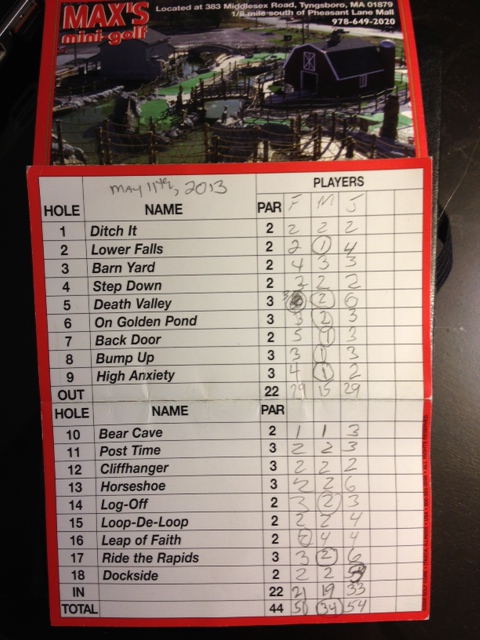
But I took greater joy in beating up the golf course.  10 under par was my score – that had to be some kind of record! 

At least for me it was.  I am framing that pictured scorecard and it is going right downstairs in the Man Room on the wall where it belongs. 

10 under!  Some team of golf course architects sat in some design laboratory in Florida years ago when they designed this course figuring out that the hole called “Cliffhanger” was a par 3 and that so was “High Anxiety” and so was that monster hole “Bear Cave”.   Heck, the Masters has names for their golf holes like “Magnolia” and “Golden Bell” and that is one tough course.

But these golf course gurus did not expect my 5 holes in one Saturday (including 4 in a row!) and nor did my son and his friend. “Go build your fragile self esteem and confidence somewhere else” I said, (like I literally did say that).  I was on fire!

I knew my concentration and skill were better than the two teenagers and that I would win, but the best part was I was way better than the “standard” of good golf – by shooting a 34 on a par 44 mini-golf course.  Expert mini golfer in the house!  I’m a darn near pro!  I will always have good feelings about Max’s Mini Golf. 

Now when you think about it, par 44 is probably a bit liberal assessment of the course difficulty.   And probably on purpose by said architects in my vision.  But it made my day. Quenched my competitive spirit it did.   It really did.  Silly I know.  But not really.   There’s something about it that’s good.   And smart.

I wonder if that “better than standard” thing has some value in the workplace and in business. – Actually, I know it does:

  • It’s the crux of the silver, gold and platinum airline classes as well as the credit cards.  Everyone knows “most people” aren’t or don’t perform at these levels so already that kind of “achievement” and expertise ( think all the “professional traveler” commercials you see of late)  taps into the emotional competitive attachment of individuals and to that of the company. 
  • Gamification is  huge in the world of learning today.  In some businesses you log into “game portals” – play games (and learn), earn points, badges and medals advancing through levels and certifications of expertise.  You know all the way along how you compare to “standards” and your peers ( where you rank) in oodles of categories.  On purpose.
  • Pizza joints love the “Beat the Pizza-mageddon” where in the space of an hour two people must eat a pizza the size of a man-hole cover and win prizes and publicity in the local paper.  “Nobody’s done it yet” the sign says.  That’ll drive more than just 2 adults to dare- they’ll bring all their friends too and order up! Bring your competitive spirit and your emotional attachment to the joint like, forever.

So fun is good.  Winning is good.  Earning stuff is good.  But having the chance to walk around town as the perceived professional mini golfer, the professional traveler, or even the pro eater is well, good for business too. 

Till next time,

Grow The Business.

Mark


Mark’s Blog

Mark’s Twitter

Stumped

Standard

stumped

Stumped

Nobel Prize winning Psychologist Daniel Kahneman said  “The remarkable thing about your mental life is that you are rarely ever stumped.” 

How interesting.  This little quote has roiled around in my head for a month.  Can’t shake it.

Think about how true it is.   Heck, I’m gonna do this or I’m gonna do that.  Or goshdarnit, I’m going to do nothing!  Bottom line is most of the time,  I know what I’m gonna do.   And most of the time we make judgements and decisions in a flash and rarely are stumped or stuck in a quandary.

I read Kahneman’s quote in the Heath Brothers latest book called “Decisive” ( big thumbs up from me). The book has some compelling methods to help us all make better decisions of course ( if we ever allow ourselves to be stumped) but that’s for a later blog or two.

Lets just chat a bit about the stumped thing.  Stumped is what I think we should be more of.  Here’s why:

  •  When was the last time you talked to a prospect, did some great discovery, built credibility and commonality, talked pain points and said, ” You know, you’ve given me some things to think about and I’m not sure exactly what the best thing to do is, let me get back to you in a couple of days.”  Answer? Never.  You’re in sales, you’re never stumped and you and I both know it. 
  • When was the last time you launched a project to tackle a problem and didn’t  pretty much have the answer already embalzoned in your brain about what you think is the right solution?  Way less than you think.  You’re not stumped.  No Never.  Not you. You can, like nobody else, see the future clearly.
  •  When was the last time you didn’t judge, label or categorize someone you just met because you were so comfortable with “waiting and seeing” what this person was really about?  Not often enough.  You’re never stumped when it comes to giving an opinion on the new person even if you just give that opinion to yourself.

The you here is me ( and yes, likely you too). 

I’ve pitched an idea or a solution well before I knew what I should really do – I should have been stumped.   I’ve launched a project ( just this week as a matter of fact) tackling a problem that I am brazen enough to think I already know the answer to, until my LEAN mentor smacked me upside the head and said “You need to be stumped in the beginning for this thing to work.”  I’ve judged someone in just 20 minutes of conversation and another in probably 30 seconds – and did it not long ago either – both are awful things to do.  Not fair and frankly, stupid.   Stumped is what I needed to be there and always. 

Not being stumped can get us into trouble; that’s the message here.  Conversely,  being stumped can do some great things like impress the hell out of a customer and get them the best help possible.  Being stumped can get your problem solved better because you didn’t presume you knew the damn answer.   And being stumped is certainly the best way to treat people you meet all the time and to get the most and the best out of that relationship.

Stumped ain’t bad.  Stumped is good.  So all you people out there with the answers ( and that means you too McCarthy) quit talking to me, I gotta work these things out like I don’t have any idea. 

Till next time,

Grow The Business.

Mark


Mark’s Blog

Mark’s Twitter


Piano Man is A Bad Song

Standard

piano man

Piano Man is A Bad Song

Who knew Billy Joel could teach us a key lesson about sales and marketing?

 Lately I’ve been really into Billy Joel again.  Not the late 80’s and 90’s Billy – Uptown Girl stuff, but the good stuff – The early stuff. 

My son (who is downright amazing on the piano), was on YouTube last month and watched the Inside the Actor’s Guild 1999 Interview with Billy Joel.  I (a piano player of a lower order) decided to check out that interview too.

And then I heard him say it.  It was stunning. 

Piano Man is really not a good song”.   He said this in reaction to James Lipton pointing out one of the most unusual things about the song – that it was in ¾ time.  It’s essentially a waltz.     

It’s a waltz but that’s not why the song is “not that good” Billy explained.   He said that the song is “so simple” and really just “repeats itself over and over again like a Limerick” with even some “La da diddy da’s” thrown in.  

He said some people know it’s bad.  Whenever he enters a restaurant or bar with a piano player these days, the musician will make eye contact and invariably start playing “Piano Man” which is all nice and good until “he realizes the song just repeats itself” and then “repeats itself some more” and “then he looks me in the eye blankly and I just nod and say “See?  Not much too it!”

I love that song.  We all love that song.  It’s a great song!

“If it’s so simple and bad, why is it so popular?” James Lipton asked.

“It’s got one hell of a story” Billy replied. 

There is was.  And there it is.  There’s Paul – who’s a real estate novelist, there’s Davy who is still in the Navy and there’s the waitress who is practicing politics.     All real people Billy explained (even Davy whose name is “Davy” and was in the Navy.)   

The point is pretty clear.  Great story makes up for a lot of things.  Some of Billy’s music is compositionally brilliant and has good to great stories in them; New York State of Mind and Scenes from an Italian Restaurant come to mind. 

But Piano Man is not a great song.   It is simple.  It does sound like Limerick.   But the story.  The Story.  The Story.   That makes it good.  And makes it stick and well, makes it awesome.

You need stories.  We all need them.  Piano Man is a lesson about how a great story needs to be wrapped inside your business, your solutions, your brand and your pitches. 

We know this.  We hear it all the time.  But we don’t always listen.   Powerful stories work hard for movies, books, businesses and I realize, music.    So all you marketers and sales people get out there and sing us that song, you’re the Piano Man!

Till next time,

Grow The Business.

Mark

Mark’s Blog

Mark’s Twitter