

Data is Nice but it Don’t Make Ya Cry

Standard

I recently read an article and buried within, was a short research snippet on the power of stories vs. data.  It was pretty cool.   Got me thinking about how to influence your clients.

The research was a social experiment where students were given $5 to use any way they wanted.  Half the group was then shown a straightforward commercial about a children’s charity devoted to removing hunger; you know – the typical fare about how many children are helped with just so much a day, how your money can sustain so many children or a family – good stuff.

The other half was shown different kind of commercial for the same charity.  It was a little story about a single child and his suffering journey through life.  He of course had a name and it was repeated often in the commercial.  He eventually found happiness and health through the charity.

The students in the first group gave an average of $1.43 of their $5 to the charity and the students in the second group some of which were teary eyed, gave an average of $2.38 (a 66% increase over the first group).

Both commercials were short presumably – maybe 30 seconds maybe a minute long- not sure.  But I do know you have to ask yourself when you are trying to help a client solve some of their business problems with your solution – are you going to rely on the facts and data to make it happen or are you going to tell a short conversational story that inspires?

Don’t give me all that drivel about how consumers are not businesses.  People are people and there’s enough research to prove that business people make decisions as much on emotion as anything else.  That means that stories that elicit joy, optimism, happiness, relief, fear and even tears can influence business people.  Data is nice but it don’t make ya cry.

Tell a short story if you want to influence and motivate.    Here are 3 tips you might not have thought of on making that happen.

Steal The Stories:  Nobody believes you when all of your stories are first-hand experience. You once had a customer find that….and you once had this other customer that did this….. and that years ago you also had this other customer…” Truth is most people that use that approach all the time are making some of it up and it feels disingenuous.    What is more believable and often more truthful is “I have a colleague James in the Dallas office who had a client  who….”  Steal the stories from your colleagues and your company. There are many if you look for them!   If you are a leader—go find the stories and share them so your people can tell them.

Make Them HumanSure in the B2B world your stories are probably about similar businesses who found your product awesome but steal from the charity experiment and make it human.  “So AMC company was freaking out about the competition and Gary over there was working weekends and nights trying to stave off and protect his client base….”   You get the idea—people feel more connected and motivated with emotion, not facts.  Also testimonials are not stories.  Stories are told – not read.

Use Stories All Over the Sales Process:  Mini-stories that support a prospect learning more, a prospect working through the RFP process, a prospect working through risk assessment, price negotiations and /or lack of budget etc. etc. are as important as any story shared to close the deal.  Find those stories through the whole selling process because done well, those stories can influence the client to keep moving to the next step.


Till next time,

Grow The Business.

Mark

Perfect Done Perfectly

Standard

In just 60 seconds, Teri G. taught me something new about giving great technical support to a small business owner by using just one simple word.   Days earlier and 600 miles from where Teri G works, Brent D. taught me something new and powerful by using the same word but in a different way.

I love to sit side by side with contact center agents any chance I get be it in sales or service.   I enjoy hearing customers live on the floor and seeing agents artfully assist them.   I enjoy the complex dance of the interests of client and agent.   There’s so much communication psychology and emotions in play often enlightening because they are compressed into interactions that last mere minutes.  Hence I enjoy most, stealing shamelessly from what works and what doesn’t.

The word Teri and Brent used is Perfect and let me tell you, Perfect works.

Teri’s Perfection; a harried small business owner calls Tech Support.  He has a product problem impacting internal communications.   This guy isn’t super comfortable with what he needs to do and has probably just a few minutes to try and fix this thing because all I can hear are door chimes and phones ringing like crazy in his shop.  Teri knows this and she knows what to do.

Teri starts with a simple instruction.  And then another.  And then another.  And then another. And then it occurs to me why the guy is so calm and almost chuckling along admitting his ignorance but hanging on her every word; She keeps saying “perfect” after each instruction is successfully done by the owner!    From the start he wasn’t sure if he was going to do this right – but he sure does now because Teri tells him he’s doing great every step of the way.  And in fact she used “You’re doing great!” and “Nice job” mixed in a bit with all those perfects.

Too often tech support agents articulate the steps to solve the problem in rote fashion because of course they do it all day.  Too often tech support agents forget a reassurance to that customer that they are doing well along the way will ease that customer tension perfectly when they need it most.

Brent’s Perfection; a harried small business owner calls.  He just needs to place a reorder for a product he’s been using for years.   But Brent needs to do verify and validate information to ensure high quality as well as do some short discovery as any helpful sales agent would.   But sometimes busy owners have little patience for all that.   Brent knows this and says, “I want to make this order is perfect for you today so I’m going to ask a couple of questions and verify a few things.”

Who doesn’t want what they are calling for to not be perfect? Who wouldn’t answer a couple of questions and verify a few things to make sure what they get is perfect?  Too often agents don’t justify their questions to customers.  Too often agent questions aren’t positioned in such a way that they have the client’s interests in mind.   Brent’s use of “to make sure this order is perfect” was simple and cleared the way for mutually beneficial discovery to happen.  It was perfect.


Till next time,

Grow The Business.

Mark

Lords of Light! 20 Words on Questions

Standard

Lords of Light! Customers will only happily answer your litany of questions if there’s value to them in doing so.


Till next time,

Grow The Business.

Mark


Mark’s Blog

Mark’s Twitter


Change (the word) Opens The Door To Sales

Standard

Dear Reader, put on your existing customer hat (either as consumer or business owner) and pretend you are calling a customer service or sales rep at a current vendor/partner for a reorder or a question and then say out loud the first word that comes to mind after reading each bullet below.

  • “We have an exciting new product…”
  • “I want to make you aware about something new”
  • “Now you can upgrade to….”
  • “There are some additional choices now….”
  • “This is actually part of a bundle now….”
  • “There is a new a new feature to think about…”

OK I can hear you!

NO!   NO!   NO!   That is the word you are saying.    And if you’re not, you’re probably lying.

Worse than you saying “No” is the fact that you the existing customer,  are shutting down your ears and your brain to hearing anything more from the cross-selling or upselling rep you are engaged with.   And dear reader since you likely working for a business in the business of profits – you need to know this happens.

Imagine if you heard this instead; And say the first word that comes to mind out loud here as well.

  • “There have been a few changes since you last called.”
  • “There is a change to the ordering platform/process.”
  • “There are some changes to the product(s)..”
  • “We’ve made a few changes to this….”

I can’t hear much!   That’s right – your reaction isn’t overt.   Mostly it’s silence or an “uh huh”.or a soft “OK” but most important, it’s a reaction that says…. tell me more…

And that is so much better than the immediate mental (or often verbal) shut down we get.    Change gets a bad rap.  It’s something people usually don’t like, but it’s different now in the world we live in with all the version 8, 9’s and 10’s we see.   Using the word change in the selling process can be to your advantage; especially when introducing new products or upsells to existing clients.  Massage your message to leverage the word as means to share the positive possibilities with the new product(s) or upgrade.  The word change makes people stop.  Change piques interest and/or curiosity.  The word change even if it raises a tiny bit of tension – creates attention.   The word Change makes people listen even if it’s only for a few seconds.

Those few seconds of attentiveness are the key.  It opens that door.  What you say after you get the attention I suspect you are already very, very good at – now it won’t be wasted!

When something changes we’re wired to find out what the change is. We have to know. That’s not always true for when there’s something new, something added, something bundled or something you can upgrade.

There’s been a change to your sales process.  The change is to start to use the darn word!


Till next time,

Grow The Business.

Mark


Mark’s Blog

Mark’s Twitter

How Long Will This Take!!??

Standard

WHI is an acronym and it’s the toughest we’ll ever face from prospects or customers in sales or marketing.  Ever.

WHI is always there.    WHI is everywhere.

WHI is

  • Who the heck are you?
  • How long will this take?
  • I don’t want to change.

WHI reminds us that we never really start on even ground.    We are deep in the hole from the outset.

Heck, WHI was in you 20 seconds ago at the beginning of reading this post.   Some of you thought “Who the heck are you?” and then “How long will it take me to read this thing?” And finally “Please don’t tell me what to do.”

That’s fine.  I know I’m up against WHI every time I write, every time I train and every time I sell.

It’s not insurmountable.   You can overcome WHI.   In fact you need to if you want to be successful.   The first step is remembering it’s there.


Till next time,

Grow The Business.

Mark


Mark’s Blog

Mark’s Twitter


The Most Interesting Sales Rep In The World

Standard

The Most Interesting Sales Rep in The World

His commissions are greater than the GNP of Denmark and Finland combined.

His typical sales contest is winning first, second and 3rd prize.

He’s made The President’s Circle so often he may just run in 2016.

His Sales Manager cries softly just looking at him.

He has his own instance of Salesforce .com

He throws live objections into his sales pitches just for fun.

His business card simply says “You’re Welcome”

He is, the most interesting Sales Rep in the world.

*****

Let’s put aside the hyperbole and fun for a moment and think about what this sales person really looks like because you know he or she must exist somewhere!.  My guess is the following is true about the best sales person in the world.

She gets cold calls from prospects asking her what they need to worry about in their industry and if there’s any way she can help them.  And why shouldn’t she? She’s known for not solving problems buyers already know about but rather the one’s they don’t.

She hasn’t prospected since Thanksgiving; her customers flood her email with friends they want her to call on.  And why would she? If you are truly the best, your raving fans do so much of the prospecting for you.

She often tells clients to hold off signing an agreement because she wants to see the right infrastructure in place first to ensure the product will deliver.  And why shouldn’t she? She knows in today’s competitive global marketplace that selling often really begins after the sale.

She’s got a killer professional social media presence that is seen as a credible resource for evolving solutions and industry trends and dynamics.  Of course she does.  She gets that buyers are researching well ahead and she’ll not wait for the phone to ring or the email or lead come in.  She’s there right from the beginning.

I may not always post a blog inspired by a beer commercial but when I do, it makes you think, no?  Stay thirsty my friends.

Till next time,

Grow The Business.

Mark

Mark’s Blog

Mark’s Twitter

It Comes With What? “Well La-Dee Frickin’ Dah!”

Standard

Gotta step it up a bit folks.

Your company (or maybe it’s you) likely spends a lot of time and effort adding values to products and services that you sell.  Try not to underwhelm your clients or prospects with your lack of focus and skill in articulating them.

If you don’t give enough attention here it’s a missed opportunity to impress or differentiate.  And worse, you can blather so boringly about some of this pretty cool stuff that the client does a mental Matt Foley (the iconic Chris Farley SNL character) and is so underwhelmed they say   “Well La-Dee Frickin’ Dah!  .  Your customers may not yell it like Matt Foley in the  5 second video but they sure as heck are saying it in their heads and all that work and investment in these added values goes wasted.

Fortunately there is a better way. 

Let’s pretend whatever it is you are selling comes with and added value of say  “One hour of free maintenance per month”. You could be like most people and just say it comes with “one hour of free maintenance per month” and then and have the client conjure up the image of Mr. Foley and “La-Dee Frickin’ Dah!”  or – wouldn’t it be better to put the client in the picture here?

  • “All we ask is that once a month, you force your busy self to sit down with one of our experts for an hour and make sure the (insert product here) is running perfectly for you.”

Now let’s pretend your product purchased comes with an added value of a “money back guarantee”.  A real snoozer because while awesome, we tend to think of it as an afterthought.   You could just say there is a “money back guarantee” (like almost everyone else does) and watch the client sleepily drool a little or – wouldn’t it be better to put the client in the picture here?

  • You expect this widget to bring in new business in and it will, but if in 3 months as you turn around and head back in from another long day on the water and you don’t feel it really has –just call me and I’ll put every dollar you spend today right back into your wallet; that’s how confident we are it’ll work.”

And finally, let’s pretend your product comes with “free fluid checks, tire rotation and oil changes for 1 year”.     In this case your product is likely a car (or a van one might park down by the river :)) .  You could just say it comes with “free fluid checks, tire rotations and oil changes for 1 year” and watch their eyes glaze over like mine do when any Friends rerun comes on or – wouldn’t it be better to put the client in the picture here?

  • Let me worry about the car maintenance – you have more important things to do.  Before you head off this summer up to Maine or NH for vacation, bring it in and we’ll check everything from rotating tires to fluids and even change the oil – all at no charge.  We’ll do that same thing before that first snow fall or just before we do the yearly inspection.  No worries and no cost to you from now till your first anniversary with this car. “

Think about added values that surround your primary products and services.  They mean something.  In fact, sometimes they are the differentiators from your competitors.  Work hard to help your clients see themselves leveraging these added values!  Use words and phrases that elicit images and mini – movies for them; it’ll elevate the value of all your stuff across the board.   And do it in a way that if you notice, compliments them as people, consumers or as business owners.  And of course,  avoid at all costs the lack of attention that results in “Well La-Dee Frickin’ Dah!”

Till next time,

Grow The Business.

Mark

Mark’s Blog

Mark’s Twitter

Verdict Day

Standard

Verdict Day

Yesterday I listened to a passionate and customer focused presentation. In it, the speaker talked about many things in the realm of customer needs and satisfaction but I was particularly intrigued by something he called “Verdict Day”.

In the story-line of any customer who purchases a product or service he said, there comes a day be it tomorrow, a week from now, a month from now or even 6 months from now, when Verdict Day arrives.

On this day, the decision is made whether the value of the purchase has exceeded the cost. This day must happen and does happen for everyone because after all, the value of anything we buy, or any partner we trust or any investment we make in consultants, employees and companies, must exceed the cost or we would not do it.

Everything your company sells no matter where you work does something valuable for a consumer or a business. I suspect we sometimes forget that in the moment, and obsess with the revenue, the commission check or the marketing glow of that awesome sale we just got and have no idea that Verdict Day even exists.

Problem is the jury is still out and Verdict Day is real but not yet arrived. And if that verdict is “no” and value has not exceeded the cost, the phone calls begin to come in, the cancellations start arriving, the positive reviews never happen, the product or service stops getting used, the emails stop getting opened and by far the worst scenario often occurs; the consumer or business never returns for more or different from you.

Verdict Day needs to be part of your marketing, sales and operations plans. It simply must be. Figure out when that day is and what you must do to be judged still worthy of your client’s investment.

Till next time,

Grow The Business.

Mark

Mark’s Blog

Mark’s Twitter

How to Better Respect Small Business

Standard

How to Better Respect Small Business

I had two recent experiences that made me think differently about respecting small businesses.  And if you are in the business of marketing, selling, servicing or supporting small business that’s an important thing.

The first was while reading some research. The research said that Small business owners overwhelmingly see themselves as unique and define themselves additionally by their unique contributions to society. 

And I thought why do we so rarely acknowledge and respect small business owners for how they respect themselves?

Sure we respect them by acknowledging their value as a customer, their membership in an industry, their work ethic, their entrepreneurship, their common pain points, their challenges, their contributions to job creation as a whole and blah blah blah…..but don’t you see it?

There is little unique about that to the Small Business owner, instead it’s a wide swath acknowledgement of them as a group which exactly not how they see themselves individually.  And there is nothing respecting their unique contributions to society.

Last week I tagged along with my wife to a local business association gathering at a new restaurant that recently opened in town.   There had to be near 40 local businesses represented sipping on wine and appetizers.

This was not how I remember these meetings way back when I used to attend in another life.   This meeting was about toasting to the “Alan’s business that is driving the benefit tomorrow night for the family who lost their home in the fire last week.” It was about the “needed sponsors for the summer band series”.  It was about how proud the association was for being the “sole group responsible for installing a landmark historic clock in the center of town”.   So little of the time was promoting their business and when they did – 80% of them shared how “different” they were than any another accountant, or restaurant, or mortgage broker, or Mary Kay representative they knew.

So why do I (and I suspect, we) forget so often what our eyes see, our ears hear and our research tells us about acknowledging and respecting a small business?

What if we were to ask more often “What are you most proud of”,  “What defines you” or “What contribution as an Small Business owner inspires you?” when we talked with small business owners? What could we do with that? What would we learn?   What if we identified their perceived or real unique differentiators and societal contributions and embedded those into our variable data printing or emails or CRM data or Facebook pages we build for them?  The leverages are infinite.

Respect anew the small business owner in the ways they respect themselves. It just makes sense.

Till next time,

Grow The Business.

Mark
Mark’s Blog

Mark’s Twitter

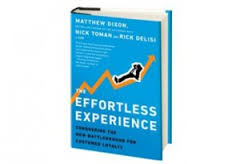
Book Review: Effortless Experience [Matt Dixon, 2013 Penguin Books, CEB]

Standard


Book Review:  Effortless Experience [Matt Dixon, 2013 Penguin Books, CEB]

Delighting your customers are you?  Waste of time.   Focusing on First Call Resolution?  You don’t get it.    Worrying about what channels customers prefer to communicate in?  Don’t be silly.

I couldn’t put this book down; read it in two chairs and one plane.

And what’s not to love with another Matt Dixon book (think The Challenger Sale) that is steeped in research from Corporate Executive Board and real life company examples of what you could truly do in the world of Service that improves loyalty, advocacy and profitability.

Dixon says and I believe him; “Service is the crucible of customer experience where all the companies’ claims, missions and values are tested.”  Gulp.

The secret though has nothing to do with service levels, getting higher satisfaction scores or striving for legendary service experiences (ya know, like the Nordstrom folks).

It’s simpler but not nearly as sexy; Reduce the effort. Don’t aim for delight, aim for relief.  Don’t dazzle customers, just fix the darn problem.   Reduce the customer effort before and after and you mitigate the rampant disloyalty that exists today.

Dixon and co. dismantle some beliefs for us too:  We have this illusion that our service departments are moments where we can inspire great trust and deeper loyalties with customers, yet data shows ANY customer service action is four times more likely to drive disloyalty than to drive loyalty.

A lot of the book focuses upstream before a customer even gets to you the service department, and delves into systems, websites and the need for simplicity.  Focus on Customer Effort Scores (CES) and not satisfaction scores.  Do that and you’ve mitigated the ease to jump ship.

Arguments and research abound about how incentivizing self-service vs. discouraging live service makes more sense.  How new hires should start their day 2 searching your websites and FAQ’s for jargon that confuses them and therefore complicates the customer experience.  How focusing on First Call Resolution misses the point that service issues are usually far more than that call but are “events” that may have begun weeks before ( like the purchase of a new service) and could continue weeks after.  How Delight based on corporate data, does not pay and how opening new ways for clients to reach you isn’t a real advantage as people will go wherever they get the best help.

I loved the robust chapters on teaching people to use “carefully crafted and thoughtful language” to engineer an experience that “actively guides a customer through an interaction”.   There is much neuroscience research there as well as in- the-trenches proven tactical applications that will have you rethinking your customer call approach.

I can’t do the book justice in less than 500 words but more than that and this post becomes an Article and not a blog.

Go get the book.  Take notes, highlight and/or export.   Study and then apply accordingly.   Here is a link to the book on amazon.

Till next time,

Grow The Business.

Mark

Mark’s Blog

Mark’s Twitter