
Easy Still Needs To Get Easier

Standard

Fax machines ain’t dead yet.   Especially in small businesses.  But of course it’s not the machine itself that matters; it’s what it still does really well that does.   I got a neat lesson about that not long ago.  

Last month I had the luck of sharing lunch with one of our operations leaders while on a visit to our Canadian facility.    He had just conducted a tour of his area that morning and was animatedly recounting the response he gave to the question about why there is still a healthy volume of faxed orders from small businesses.

“Here’s why…” he said and deftly picked up an imaginary order form, proceeded to circle an imaginary box, write in an imaginary quantity and then stick it into an imaginary fax machine. Done.

Sweet.  Simple.  Quaint even.  So Easy.

And that is the point.   For a small business, it is easier (and sometimes a heck of a lot easier) to stick with the old than go with the new “Easier Ways”.

Let’s take an online reorder of a product.  Maybe it’s new name plates, or business cards or truck parts or whatever.   And think about the online ordering process experience from just about any company.

In this typical small business you’ve got to find a computer you can use to place this order (it’s not like everyone at a small business has one readily available)…. open up a Browser….find the Vendor…. get past the “Sell” area landing page and find the Existing Customer area (you know up at the top right somewhere…. in the tiny print)….. find that Sign in button….. Enter Email address…. Login name… remember or dig for, the darned Password….. Place the order…. Verify…. Validate…. etc etc.  Is it simple? Yes, for some.

But some find it “easier” to grab the reorder form that was mailed to them, circle a spot, write in the quantity and fax it. 

Others find it easier still, to remember nothing at all other than the bloody company name, pick up the phone, talk to a human and place a reorder.  

This isn’t a knock on web plays for small business; this is a reminder that “Making it Easier” is a critical factor for small businesses.  And always will be.

Warrilow (a leading researcher of small business) often reminds us that the majority of small businesses are not early adopters of technology but I’d contend that is as much about how easy (or not)  something new is to do versus how easy it is to do today as anything else- especially for small business.

So two easy questions to ask yourself when you are trying to provide support and solutions for your small business customer;

  • How can your recommendation “make things easier” than the current product and/or supplier in use today?  Write down those answers for your favorite products and embed them in your contacts and conversations.


  • Is the reason a SB won’t budge or buy really because the solution will require “more work” on the clients’ part than they do today? (Even if just in the transition?)  If yes, remove the work!   Invest in whatever it takes to do this; the return you get versus price obsession or proving ROI will be significant.


Till next time,

Grow The Business.

Mark
Quit Worrying About Sales

Standard

Quit worrying about making sales, sales people.

Quit worrying about the sales results, marketing people.

Quit worrying about sales performance at all, leaders of any type.

Just stop.   

Sales are not the issue here.  Meaningful Conversations are the issue.  We don’t have enough of them.

  • Worry more about that in the 81 customers you spoke with today, you only had 9 meaningful conversations; conversations about helping them solve a problem or to make things better or something.  Move that meaningful conversation number to 19 a day and more sales will follow.
  • Worry more about the 43  Voicemail messages you leave everyday and that maybe just 3 customers on average ever returns your darn call.   Work on making those voicemails more compelling and interesting and get those returned calls to 10 and more sales will follow. 
  • Worry more about how to entice a customer to hear (just hear! not buy anything) about how your company is different or better or smarter than the competition.  Worry about that and worry hard, and more sales will follow.
  • Worry more about how and which ways to get meaningful conversations going customers than worrying about all the tracking sheets, the coaching conversations, the sales huddles, the campaigns, the contact plans and the emails largely focused on you and “where you are with the numbers” and “where you need to be”.  Instead of worrying about the what, worry about the how and sales will follow.
  • Worry more about fixing “the wrong problem” for if you do fix it –  it is the absolute worst thing any person or organization can do.  Fixing the wrong problem ( “I need sales!”) results in sales that cancel in a month and litter the prospecting landscape with your bad name and arm twisting tactics.   Sales is the “wrong problem” to worry about people, it really is.  

Meaningful Conversations on the contrary, are well worth your worry and mine.  

Till next time,

Grow The Business.

Mark

Treat Your Boss Well

Standard

Treat your boss well.  It’s always the other way around, isn’t it?

Kevin Spacey had it rough as the sales boss in Glengarry Glen Ross.  Lots of bosses have it rough.

And I’ve yet to see a book on the shelves, or in a training class, or a webinar,  or darn near even a memo with topics like “How to Treat Your Boss Better” or “Strategies to Engage Your Manager” or “Connecting With Supervision: Unleash The Power”

Nope.  It’s all about what the bosses should do for their employees.  How to be a better manager, coach, teacher, helper or leader of people.

I got it already.

We have to turn the tables.  We’re missing chances to make this third of our lives that is work, just a little bit better.

  • Treat your boss as if you know they once “carried the bag” and like you, had some rough sales quotas to hit, impossible project deadlines to meet or tough service issues to handle.  They had those then and unless I’m missing something, still have them today.
  • Treat your boss as if you know they have a hard time sleeping some nights worried about you or your colleagues, or the business, or even the systems.  Truth is, the lack of sleep isn’t always because they were out too late the night before.
  • Treat your boss as if you know that being a leader or a coach of people (and some bosses in this sales business have 20 + direct reports) is one of the toughest jobs anyone could ever do.  Never doubt for a moment it isn’t, because it is.
  • Treat your boss as if just like you, they have a family at home, maybe a sick child, or an ailing parent or a bill they are worried about having to pay because without a doubt, they do.
  • Treat your boss as if you appreciate they are often anxious and worried about what they are saying to you or the team or even what they will say or will do.  They know they are never ever not on stage and that everyone is always watching.
  • Treat your boss as if you know they took their leader job because maybe they get real joy out of helping someone turn “just a job” into a career or to take a team or a business from “just good” to “darn great”.   Leaders yearn for that job satisfaction too.

Till next time,

Grow The Business.

Mark

6 To Ponder

Standard

These 6 questions are rarely ever posed as questions.  Everyone just presumes what the answers are.   That in itself is questionable.

Bring these questions into your next staff meeting or into your next business building brainstorming session or hell, just print em’ off and bring them to bar after work with some of your colleagues.

Discuss these questions.   Questionable stuff these questions are and they need some good answers.   Take your time, they’re biggies.

  1. Almost everyone says the key to Sales is “Listening”.   But what good is being a great listener if you can’t get your customer to truly talk to you?  And really, isn’t that the bigger problem these days? 
  2. If your Mantra is “Sell, Sell, Sell!” but you spend 90% of your day teaching and preaching only to efficiencies and work habits, should you change your Mantra or change your approach?  
  3. Isn’t it true that overcoming customer objections is the least of our worries compared to not having enough true customer objections to begin with?  
  4. When will the Content quality of Social Media become more important than the fact that media has become more social? 
  5. Instead of leaders trying to get people to be really good at 5 different skills at work; what if we created just more opportunities for them to do what they do well?  Wouldn’t we all be more successful?  
  6. Do we really think we can train tone, empathy, enthusiasm and sincerity in a training class?  Isn’t that like trying to train someone to be intelligent?

You’ve got some strong feelings on the answers or have more questions to ponder I bet.  We’re all ears.

Till next time,

Grow The Business.

Mark

WWSBD?

Standard

What Would Small Business Do? 

Sometimes the best advice to get more sales comes from the very customers you sell to.  

And I bet some of us sell and support Small Businesses.   Small Businesses are great teachers.

Let’s say a small business has a chance to have a very strong sales finish to this month, a chance to deliver results like never before.   Maybe you or your sales folks are in the same boat.

And let’s say it’s a big deal for this small business. The pressure is on.   Maybe their bank needs to see some strong performance before they’ll agree to extend more credit the business needs.  Maybe this small business is trying to attract investors as the owner knows he wants to open 2 more locations.  Maybe this small business is just trying to prove to itself and its employees that they are going to make it out of this recession healthy and strong.

We could learn a lot from what a small business would do with this opportunity.  Heck we have a business to run and sales to make this month too.

What Would Small Business Do? 

All Hands on Deck:  Grandma made the trip down from Maine to work the prep tables.  The high school kids got out of school last week (thank god) so they are both here to help at the lunch counter.  For us it’s simple; Be here.  Be present.  If you have folks who do the training, the accounting and the marketing, whatever- get them out and into the store and on the floor or in the field: everyone needs to focus on getting the cash register to ring.  Do whatever you can do.

Be Extra Nice and Extra Helpful:  “Pay attention to everyone that walks in today!  Smile, offer to help, make eye contact!  Don’t let anyone back out that door without saying hello!” the owner said before the small men’s clothing store opened.  You see he knows this week is a week you can’t just “wait” for sales to come to you, you have to make them happen.  For us, it’s the same.   Smile on that phone.  Listen real closely.  Get those calls before they sit for even a second in queue and don’t you dare let a voicemail go unreturned for more than an hour!   Amp up your “thank you’s”, your apologies, your energy, your tone and your passion.  Make it happen; don’t wait for it.

Have a Special:  Cousin Billy always has the good ideas so he went out front and changed the sidewalk sign to an auto detailing offer good for only this week.   That’ll draw them in!   You have to get creative and get attention sometimes to nail those dollars late in the game.  For us at we have those “specials” all the time; – tons of them.  It’s up to us though to get that sense of urgency out about them. “The month is almost over for this one so I’d recommend….”, “I don’t usually see this kind of offer, so my advice is to take advantage of it…”.  You get the idea; make this week, this month, a big deal for the specials you have going. 

Work Harder:  This family owned shop knows a lot about this already but this week they know it’s going to have to be at another level.  They’ll stay later and restock the shelves of this little grocery outlet every night instead of every other.  They’ll get in earlier and rather than wait till July, set up the outside produce display this week and maybe attract a few more folks to stop in.   For us at  working hard isn’t new but this week we know that that 40th  incoming call has to sound to the customer, like it’s your first call if you want to make a difference.  We know making 10 more outbound calls from 4:30-5:30pm than usually do or 3 more customer visits per day this week could make the difference.  We understand it’s a full court press of effort and yeah, it’s gonna be exhausting.

Till next time,

Grow The Business.

Mark

Pretend You Have No Choice

Standard

When we go to a new product training we have no choice but to learn because if we don’t, we won’t know the prices, the models, the features or the options available.  And we’ll sound unprepared and unprofessional in front of the customer.  

When we go to a systems or CRM training we have no choice but to learn because if we don’t, we won’t be able to enter an order, research customer history, look up a price or navigate anywhere.  And we’ll sound unprepared and unprofessional in front of the customer.

But somehow when we go to a sales skill training, or a negotiation training, or a customer service training, we think we have a choice to learn or to not.  Somehow because our system won’t lock up or we don’t fumble for the right pricing or we always find the history we are looking for, we think this kind of training is optional to apply.

Truth is if we choose not to learn and apply in these types of trainings we will sound woefully unprepared and unprofessional in front of the customer.

More and more today, what you say to a customer and how you say it is critical to differentiating you and your company from others.  Remember that customers today need less and less human interaction to get information; what they need and get from our live conversations however,  is the experience and that is a big deal. 

Pretend you have no choice when it comes to learning in these types of soft skills trainings.  Just because the path forward after the class doesn’t change and force you into learning the topic doesn’t negate its value.       

Till next time, 

Grow The Business.  

Mark
The Devil’s Claw

Standard

I was shocked.  I was thrilled.   And then, I was completely ticked off. 

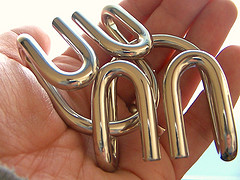
I’ve had this puzzle for almost a year.   It’s called the Devil’s Claw.  

You can get these at any Barnes and Noble and this one is rated “Challenging”.   The key is to get the darned thing apart into the two pieces.  I’ve tried.  My wife has tried, my daughter has tried,  my son had tried, my son’s friend has tried, unsuspecting party goers and holiday revelers have tried as I’ve begged many to just “ give it a go” and figure out a way to get the Devil’s claw apart.   

I like the puzzle.

It represents something too, this puzzle.  It must be defeated because well, it just has to be.  Hanayama, the company that makes the puzzle, specializes in recreating these puzzles from the 19th century and knows that there are thousands of people like you and me who need this type of challenge.     We tackle puzzles every day at work, but we sometimes want  more.  

At exactly 9:47 pm, I was sitting in the Man Cave (yep, I got one of those).   The Discovery channel was on (something about submarines), the laptop open and email up, a Bud Lite nearby too close to empty and as I was apt to have,  the Devil’s Claw was in my hands.

And……then…..

It came apart.  One piece in my left hand ….and one piece in my right hand. 

I was shocked.  I was thrilled.   And then, I was completely ticked off.   

I jumped to my feet.   Finally, after so much time had passed, I had defeated the Devil’s Claw.    The only problem was, as I began to head upstairs to exclaim to my wife that I had conquered the devil himself,  I realized that I had no idea how I did it.   I had taken it apart but had no idea how.  None. 

That was not good.  That was really not good.  That made me angry.  And then as I paused, it made me realize how often this happens.

I wanted to share how had succeeded.  I needed to share how I succeeded.  I actually needed to know how I did it.

When you succeed today at work, perhaps landing a colossal sale, are you absolutely sure how you did it?   Do you know exactly what steps you took, what process, what angles, what words, what perspective you took to make that success happen?

What exactly was the way in which you were able to take your Devil’s Claw apart?  When your colleagues, boss or spouse ask “How did you do it?”   Can you respond in a specific way?

You need to.  And often, too often, it isn’t easily explained.

Over the years, I have heard many success stories, so many difficult yet successful stories in which a sale was made, a solution solved, a customer indebted for life to you because of what you did.   And over the years, the how is often lost.

The how gets buried in the “It was magical, they ended up buying the whole suite!” or the “I just went with it” or the dreaded “because I’m a good salesperson.”  The how is forgotten.

Even the “I kept probing until I discovered” or “I wouldn’t take “no” for and answer” or the “I just knew we had what they needed” is akin to that playing mindlessly as I did with the Devil’s Claw in my lap and having it fall apart in my hands.

Success without knowing how, is not success, it is Random Achievement.  Random Achievement isn’t something you or I want.  What we want is success that we can understand and explain.  Success that is understood in minute detail is repeatable and wonderful.

Every manager, sales leader or marketer out there should be asking the questions of the successful salesperson about that successful sale and exactly what happened.   Don’t settle for the vague answers or the generalizations.  Salespeople who are successful may or may not be aware of how they accomplished the feat; (I know that years ago as a salesperson, it took me time before I was consciously aware of how I succeeded).  Your job as a leader is to delve deep into that space and “CSI” the event giving the salesperson and the respective populace the recipe for achieving this specific success. 

Random Achievement is great at the time, but it is no longer random when it falls identifiably upon people with some consistency.   The Devil’s Claw for me was a Random Achievement.   It did not have to be.  I’ve been working on that puzzle for nearly a year. 

Watch closely.  Watch how.   

I went to Barnes and Noble yesterday and got two more puzzles, both more difficult supposedly than the one I unknowingly conquered.  

The devil made me do it.   But this time, I’ll be watching. 

Till next time,

Grow The Business.

Mark

Ugh! The World Cup Soccer Sales Approach

Standard

I figured out why some of our sales efforts don’t work so well.   We sometimes use the World Cup Soccer Sales Approach.  

I tried watching the World Cup over the weekend.  I did.  I watched England vs. USA and Germany vs. Australia.    I was annoyed, confused and bored.    I walked away.  

Thankfully those 5 hours I wasted made me realize that the World Cup Soccer Sales Approach is dangerous.  Use it on prospects and customers and they too will become annoyed, confused, bored and walk away.   

In order to see if you suffer from using the WCSS approach let’s take a look at the nasty 3 step problem that is World Cup Soccer and its sales counterparts.

Step 1Annoy Your Audience.  The trumpets have got to go.  That incessant drone (and it really does sound like angry bees) is all that you hear.  It borders on inane.   This is white noise of the worst kind; white noise that is too loud and won’t go away.   White noise like this can be damaging to sales especially when we cold call (or warm call) customers or prospects poorly.   For those 10, 30 or 120 seconds of you spouting your benefits, or “our possible fit” and other drivel like “I can save you time and money” these folks hear blaring in ear and brain self talk like “How do I get rid of you!”, “Can I just hang up???…” I have got real work to do!!.   Annoying white noise is a big deal especially when practicing interruption marketing or sales.

Step 2 : Confuse Your Audience:   I’m not following what these guys are doing with the ball.  Moving forward, passing backward 3 times, moving forward, and passing backward again and again.  And offsides?; impossible to figure out even in replay.    How often does your client or prospect get bounced or passed around to someone and they don’t understand why either?  How often, just when your client thinks they are moving ahead, does she have to tell her story repeatedly to customer service, technical support, an account manager or in chat?  Confusion causes tension and tension stops sales.

Step 3:  Bore Your Audience:   This is the worst because if you can somehow get past the trumpet blaring white noise and figure out the confusing way to work with your business then it all goes for naught if you are downright boring.  I heard a joke over the weekend that that soccer call “gooooooooaaaaaaaaaaallllllll!!!” is really an alarm clock for the sound asleep American on the couch.  My wife was sound asleep watching soccer with me (her last utterance something like.. “nothing is…happening…” ).  And while the commentators never yelled “goal” like in the joke to wake her, the point is not lost.  Boring does not sell.   If your business is unremarkable (especially after that first sale) then your clients and prospects will walk away.   

Till next time,

Grow The Business.

Mark
You Got Facts? So What?

Standard

It’s not the size of your knowledge that matters, it’s what you do with it that counts. 

You see, facts are getting less and less valuable every day.  They are just too easy to come by.

I saw two people sitting at a bar the other night playing that trivia game thing; you know the one you pump the quarters into and try and get the highest score.  One of them had an IPhone.    Fastest animal?  No problem, just Google it.  Superbowl X Champion?  That’s easy…Badda -Bing it.  Tallest skyscraper?…Yippy- Yahoo it.  

Game over.   That was fun.   Game means nothing now and so does your score.

Got a new video game for your kid?  Most 12 year olds go online, get the Cheatin’ facts and get the game codes.   Game over.   Good for you that you defeated Tyranna KingZilla, means nothing to me (and really to anybody else either).

Used to be that knowing a lot of facts nobody else knew actually meant something.  Meant you were smart.  Meant you had value.   Not anymore.

If you are the Keeper of the Knowledge, the Knower of All Things or the Encyclopedia of Vital Stuff, good for you except your days of being truly valuable are numbered.  

And that’s OK. 

Knowing facts or having knowledge all by itself had its day, but that was so yesterday.  

  • You’re a plumber who knows how to fix a leaky faucet.  So what? In a heartbeat I can go to ehow.com ( http://www.ehow.com/video_15854_fix-leaky-faucet.html ) and get all kinds of facts by watching a video on how to fix my faucet.  You’ll never get my call.
  • You’re a sales rep who knows every product, every process and every procedure ever created.  So what?  If you are up against someone who has great sales skills and a good search engine, you’ll get the steak knives and he’ll get the Cadillac.


It’s not about you knowing stuff no one else knows anymore.   Your customers and your competition can know pretty quickly what you know as far as facts go.  It’s about having the skills to do something with the facts.  The skills and applications and ability to seamlessly and proactively use facts to market better, to sell better, to strategize better and to differentiate you from just being a repository of those darn facts. 

That’s a good thing.

People and businesses that can do those kinds of things well will grow in value. 

So chill a bit about the facts (you can get those so much more easily now) and work on the skills.   That’ll make you stronger and nobody for a long time (maybe never) is going to say “so what?” to that.    

Till next time,

Grow The Business.

Mark

Interrogation Is Not A Sales Strategy

Standard


You do it all the time.

When online, if you make me fill out anything more than my name and email address just so I can just learn more about your company or your product; then you believe that interrogation is a sales strategy.    And I will summarily go sign up for somebody else’s Webinar at their website and grow their business instead of yours.

When at the do it yourself superstor you ask me (after I politely ask you where something is…) questions like “If you were going to remodel your garage or your kitchen, which one would it be?” and without even taking another breath add, “And if it was the kitchen, would you have to move the stove or the sink?”; then you believe that interrogation is a sales strategy.    And the next time, when I need drywall screws or darned near anything else, I will go somewhere else. (His name was Steve and I kind of feel bad he was trained like that- seemed like a nice kid.)

When I call to order more business cards and you pepper me with six questions about my small business without so much as offering an ounce of proof that you even understand small business; then you believe that interrogation is a sales strategy.    And I will not buy another product from you.

Interrogation can be many things, but it is decidedly not,  a sales strategy.

Quit it.

Till next time,

Grow The Business.

Mark