You Wouldn’t Think…

Standard

You wouldn’t think you’d get farther by doing things that feel weird or counterintuitive to sales, but you will.

  • You wouldn’t think you’d get farther by asking “Can you help me?” vs. “Can you tell me?” but you will.  People like to help people more than they like to serve people.


  • You wouldn’t think you’d get farther by fumbling your voicemail message than by delivering it perfectly, but you will.  People like real imperfect people more than real perfect people.


  • You wouldn’t think you’d get farther by not trying to close on every call vs. saying “Let me walk away and think about this” but you will.  People like people who listen and think more than they like people who just listen and solve.


  • You wouldn’t think you’d get farther by saying “Thank you for your business” vs. “Is there anything else I can help you with today?” but you will.  People more than ever; remember being appreciated rather than the check to see if their wallet was still open.


  • You wouldn’t think you’d get farther having a catalogue, a brochure or a handwritten letter in your tool belt vs. just landing pages, links and emails, but you will.  People like to do more than just surf sometimes; people also like to swim.


Till next time,

Grow The Business.

Mark

5 New Rules For Book Reading

Standard

After a recent conference meeting, I offered to send out a particular book to any sales leader who wanted one of my remaining stash.  Many folks replied requesting the book and my guess is that others used the link I provided to purchase the book at Amazon. 

Super.  I love people who read business books.  They get it.  

It was a little odd though.

Some sent notes saying things like “Please send the book and I’ll pass it on to each leader” or “I’ll send back it back when I am done with it”.  These notes are from people wanting to invest in themselves and are very well intentioned for sure.  I’m convinced though, that our “Library” experiences and our “Textbook” experiences in school have fostered the belief that all books should be treated as we once were instructed to, or as we might treat fiction books today; That books are to be read and read only; That books are to be passed around, or resold or covered in protective paper and never, ever to be written or doodled in.  

It’s time for the old rules to go.  I don’t think those beliefs suit us well when applied to essential books.  These types of books I’m talking about can change your life at work and at home.   

Here are 5 new rules to go by.

1) Never Share:

It’s yours.  You wanted this book to read.  You will, if you do it right, write in this book including in the Kindles of the world.  In a mad rush some day in the future, you’ll lunge for your bookcase because you know that there is this book or this author who has that idea  and you need to read it again to move this effort forward or make something happen.  Make sure that this book is in your bookcase or on your desk when you need it.  Recommend a book?  Yes.  Share a book?  Never. 

2) Never Borrow:

Never borrow one of these types of books from anyone.  Not your colleague, not your spouse, not your friend.  Borrow means you have to give it back.  Borrow is a complete waste of time.  Think you can read a non-fiction critical book and remember the 10 essential themes or tools it teaches?  If you can, welcome to the tiny percentage of folks with a photographic memory.  The rest of us need to skip the “borrow” approach to books.  Never borrow.  Leave that to the fiction and fun books. 


3) Always Write In and Highlight In Your Book:

Have a pencil and your favorite color highlighter in hand whenever your read one of these books.  If you are into the electronic readers be careful; you have to get the ones that easily allow you to write, highlight and retrieve (and Nook ain’t one of them).  Books are a collection of moments from great teachers, researchers and leaders and like anything else, offer some moments that are better and more striking than others.  Highlight them or write a note next to that moment.  Your books should be a complete mess of color and notes.  It makes it that much easier a year later or 10 years later, to pick up this book and find what you loved about it the first time you read it.


4) Spend Money:

Spend at least $60 of your own money every month on books.  About a $2 dollars a day on ways to be better, be happier, be smarter or be more of whatever it is you want to be.  You decide if you are worth it but if you are reading this, my guess is that you are.  


5) Re-Write the Best:

If you take the time to read these types of books (and you must), do so with a small notebook that you’ll never lose (I use a small red moleskin notebook).  When you read, there are concepts that on occasion will make your jaw drop, your eyes widen and your breath quicken as within this book and on this page, a brilliant perspective screams out to you.  These thoughts are so profound that a note or highlight just won’t do and in fact, you should carry it with you. Transfer that tremendous thought to your small notebook.  Carry it with you and look at it often. 

Till next time,

Grow The Business.

Mark

Quit Worrying About Sales

Standard

Quit worrying about making sales, sales people.

Quit worrying about the sales results, marketing people.

Quit worrying about sales performance at all, leaders of any type.

Just stop.   

Sales are not the issue here.  Meaningful Conversations are the issue.  We don’t have enough of them.

  • Worry more about that in the 81 customers you spoke with today, you only had 9 meaningful conversations; conversations about helping them solve a problem or to make things better or something.  Move that meaningful conversation number to 19 a day and more sales will follow.
  • Worry more about the 43  Voicemail messages you leave everyday and that maybe just 3 customers on average ever returns your darn call.   Work on making those voicemails more compelling and interesting and get those returned calls to 10 and more sales will follow. 
  • Worry more about how to entice a customer to hear (just hear! not buy anything) about how your company is different or better or smarter than the competition.  Worry about that and worry hard, and more sales will follow.
  • Worry more about how and which ways to get meaningful conversations going customers than worrying about all the tracking sheets, the coaching conversations, the sales huddles, the campaigns, the contact plans and the emails largely focused on you and “where you are with the numbers” and “where you need to be”.  Instead of worrying about the what, worry about the how and sales will follow.
  • Worry more about fixing “the wrong problem” for if you do fix it –  it is the absolute worst thing any person or organization can do.  Fixing the wrong problem ( “I need sales!”) results in sales that cancel in a month and litter the prospecting landscape with your bad name and arm twisting tactics.   Sales is the “wrong problem” to worry about people, it really is.  

Meaningful Conversations on the contrary, are well worth your worry and mine.  

Till next time,

Grow The Business.

Mark

6 To Ponder

Standard

These 6 questions are rarely ever posed as questions.  Everyone just presumes what the answers are.   That in itself is questionable.

Bring these questions into your next staff meeting or into your next business building brainstorming session or hell, just print em’ off and bring them to bar after work with some of your colleagues.

Discuss these questions.   Questionable stuff these questions are and they need some good answers.   Take your time, they’re biggies.

  1. Almost everyone says the key to Sales is “Listening”.   But what good is being a great listener if you can’t get your customer to truly talk to you?  And really, isn’t that the bigger problem these days? 
  2. If your Mantra is “Sell, Sell, Sell!” but you spend 90% of your day teaching and preaching only to efficiencies and work habits, should you change your Mantra or change your approach?  
  3. Isn’t it true that overcoming customer objections is the least of our worries compared to not having enough true customer objections to begin with?  
  4. When will the Content quality of Social Media become more important than the fact that media has become more social? 
  5. Instead of leaders trying to get people to be really good at 5 different skills at work; what if we created just more opportunities for them to do what they do well?  Wouldn’t we all be more successful?  
  6. Do we really think we can train tone, empathy, enthusiasm and sincerity in a training class?  Isn’t that like trying to train someone to be intelligent?

You’ve got some strong feelings on the answers or have more questions to ponder I bet.  We’re all ears.

Till next time,

Grow The Business.

Mark

Pretend You Have No Choice

Standard

When we go to a new product training we have no choice but to learn because if we don’t, we won’t know the prices, the models, the features or the options available.  And we’ll sound unprepared and unprofessional in front of the customer.  

When we go to a systems or CRM training we have no choice but to learn because if we don’t, we won’t be able to enter an order, research customer history, look up a price or navigate anywhere.  And we’ll sound unprepared and unprofessional in front of the customer.

But somehow when we go to a sales skill training, or a negotiation training, or a customer service training, we think we have a choice to learn or to not.  Somehow because our system won’t lock up or we don’t fumble for the right pricing or we always find the history we are looking for, we think this kind of training is optional to apply.

Truth is if we choose not to learn and apply in these types of trainings we will sound woefully unprepared and unprofessional in front of the customer.

More and more today, what you say to a customer and how you say it is critical to differentiating you and your company from others.  Remember that customers today need less and less human interaction to get information; what they need and get from our live conversations however,  is the experience and that is a big deal. 

Pretend you have no choice when it comes to learning in these types of soft skills trainings.  Just because the path forward after the class doesn’t change and force you into learning the topic doesn’t negate its value.       

Till next time, 

Grow The Business.  

Mark

Bad Service? Maybe You’re The Problem

Standard

I’ve been watching you.

Yeah, that chill you got last Saturday while shopping was probably me. 

And some of you folks are no treat to deal with. 

But before I get into that, let’s talk about Bad Service.  It gets all the press.  Bad service gets Twitter all atwitter as people write about their bad experiences at Best Buy or with HP or at the local Mini Mart.    Bad service gets all the chatter in the hallways and the lunchrooms as people talk about the rude waitress or the incompetent accountant or the indifferent business owner.

But I’ve been watching you.  And it often takes two to tango.    

A big part of the problem with Bad Service may be you.

I saw you at the check out line in Costco when you didn’t even think to put those heavy items in your cart with the bar code facing up or god forbid, hoist them up on the belt.  Nope, that’s not your job.  Then I saw you get all snippy thinking the cashier lady (who weighed all of about 90 pounds) was being too rough with your stuff as she struggled mightily to lift items so she could scan.   I blame you for that Bad Service experience.  

I saw you never even look up at the gas station clerk as you ignored her outstretched hand and instead placed your $20 bill on the counter for her to retrieve it.  She responded in kind and placed your change right back on the counter where you dropped your cash.  I saw that look as you clumsily collected your bills, quarters and pennies.  I bet you complained about that experience later but I blame you for that Bad Service experience.  

I saw you tell that animated story to your husband about how you showed up “wicked early” Monday morning at the Auto repair shop to get that muffler fixed (early for you being 8:30 am I guess…) and how ticked off you were that “they couldn’t tell me how long it would take” and that you had “to call back like at 1pm and it still wasn’t done!”.   I blame you for that Bad Service experience.

My guess is that a lot of you see this kind of thing happening too.   And maybe it’s not just at the store.  Maybe you see it happening at work.  Bad Service at work gets a lot of attention too.  But maybe people who say they are getting Bad Managing or Bad Teamwork or Bad Advice aren’t totally blameless.   Maybe we should take a closer look at all those “Bad Service” claims altogether.  

Here’s watching you.

Till next time,

Grow The Business.

Mark

The Devil’s Claw

Standard

I was shocked.  I was thrilled.   And then, I was completely ticked off. 

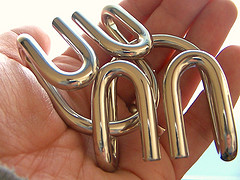
I’ve had this puzzle for almost a year.   It’s called the Devil’s Claw.  

You can get these at any Barnes and Noble and this one is rated “Challenging”.   The key is to get the darned thing apart into the two pieces.  I’ve tried.  My wife has tried, my daughter has tried,  my son had tried, my son’s friend has tried, unsuspecting party goers and holiday revelers have tried as I’ve begged many to just “ give it a go” and figure out a way to get the Devil’s claw apart.   

I like the puzzle.

It represents something too, this puzzle.  It must be defeated because well, it just has to be.  Hanayama, the company that makes the puzzle, specializes in recreating these puzzles from the 19th century and knows that there are thousands of people like you and me who need this type of challenge.     We tackle puzzles every day at work, but we sometimes want  more.  

At exactly 9:47 pm, I was sitting in the Man Cave (yep, I got one of those).   The Discovery channel was on (something about submarines), the laptop open and email up, a Bud Lite nearby too close to empty and as I was apt to have,  the Devil’s Claw was in my hands.

And……then…..

It came apart.  One piece in my left hand ….and one piece in my right hand. 

I was shocked.  I was thrilled.   And then, I was completely ticked off.   

I jumped to my feet.   Finally, after so much time had passed, I had defeated the Devil’s Claw.    The only problem was, as I began to head upstairs to exclaim to my wife that I had conquered the devil himself,  I realized that I had no idea how I did it.   I had taken it apart but had no idea how.  None. 

That was not good.  That was really not good.  That made me angry.  And then as I paused, it made me realize how often this happens.

I wanted to share how had succeeded.  I needed to share how I succeeded.  I actually needed to know how I did it.

When you succeed today at work, perhaps landing a colossal sale, are you absolutely sure how you did it?   Do you know exactly what steps you took, what process, what angles, what words, what perspective you took to make that success happen?

What exactly was the way in which you were able to take your Devil’s Claw apart?  When your colleagues, boss or spouse ask “How did you do it?”   Can you respond in a specific way?

You need to.  And often, too often, it isn’t easily explained.

Over the years, I have heard many success stories, so many difficult yet successful stories in which a sale was made, a solution solved, a customer indebted for life to you because of what you did.   And over the years, the how is often lost.

The how gets buried in the “It was magical, they ended up buying the whole suite!” or the “I just went with it” or the dreaded “because I’m a good salesperson.”  The how is forgotten.

Even the “I kept probing until I discovered” or “I wouldn’t take “no” for and answer” or the “I just knew we had what they needed” is akin to that playing mindlessly as I did with the Devil’s Claw in my lap and having it fall apart in my hands.

Success without knowing how, is not success, it is Random Achievement.  Random Achievement isn’t something you or I want.  What we want is success that we can understand and explain.  Success that is understood in minute detail is repeatable and wonderful.

Every manager, sales leader or marketer out there should be asking the questions of the successful salesperson about that successful sale and exactly what happened.   Don’t settle for the vague answers or the generalizations.  Salespeople who are successful may or may not be aware of how they accomplished the feat; (I know that years ago as a salesperson, it took me time before I was consciously aware of how I succeeded).  Your job as a leader is to delve deep into that space and “CSI” the event giving the salesperson and the respective populace the recipe for achieving this specific success. 

Random Achievement is great at the time, but it is no longer random when it falls identifiably upon people with some consistency.   The Devil’s Claw for me was a Random Achievement.   It did not have to be.  I’ve been working on that puzzle for nearly a year. 

Watch closely.  Watch how.   

I went to Barnes and Noble yesterday and got two more puzzles, both more difficult supposedly than the one I unknowingly conquered.  

The devil made me do it.   But this time, I’ll be watching. 

Till next time,

Grow The Business.

Mark

Perfect Games in Sales & Marketing

Standard

In baseball there is all the rage about perfect games this year.  But it’s not whether there have been two or three perfect games (I say 3) this year that strikes me.   What occurs to me is the tremendous advantage baseball has to know what perfection looks like.

In baseball, you know what a perfect game should look and feel like when you get there.   You can envision the 3 hour battle, the tension rising, the crowds standing all throughout the 9th inning and the euphoric on field celebration as the 27th consecutive batter is retired. 

In Sales and Marketing you aren’t sure what that perfect campaign or sale looks or feels like whether you are a big company, small business   or sell for yourself.   Wouldn’t it be great if we knew what a perfect sales or marketing campaign looked like?

If you knew, you could better build the path, the processes and the tools you’ll need to get there.  And when we you see a vision of perfection you can measure better your performance in sales and marketing comparatively.

Don’t take the easy way and say a perfect game in a sale or a marketing campaign would exceed revenue results, would be done ahead of schedule and under budget.  That’s not a perfect game.  Here’s the scorecard for real perfection.

A Sales/Marketing Perfect Game

1st Inning:  You took a big risk.  You targeted a new market.  This campaign, this sale is a game changer; no tiny incremental move here; you are going for it.

2nd Inning:  Before you’ve sold anything, you’ve ‘sold” everyone on your team first.  You get the Manager on board, your colleagues, your teammates and you’ve got them all ready to play like hell for you.  No lone ranger here, the most brilliant sales people and marketers don’t do it alone.

3rd Inning:  You are obsessed with differentiation.   99% of us have at least 1 competitor.  In this perfect game your lead story sets you apart in such a way that you create a buzz offline and online; just like a high and tight fastball buzzed inside gets attention.

4th Inning:  You are obsessed with credibility.  The marketplace today is trust starved.  The internet is the gathering place for pseudo soothsayers and the volume of baseless advice is endless.   In this perfect game you pull out all the stops, pick up the best radar gun and prove how credible you and your company are. 

5th Inning:  You focus on your prospect or your targeted market’s time.  It’s scarce and more valuable than ever.  The perfect campaign respects this.  The perfect campaign invests in this.  Maybe even pays the prospect just for their time.  Knee jerk spray and pray selling or marketing is the bane of the 6 hour, 9 to 8 game that is far away from perfect and creates indifferent fans.

6th   Inning:  This perfect sale doesn’t hit the prospect or the market just at the right time, no siree.  This perfecto takes   perfectly normal consumers or businesses that have no interest in what you have to sell, have no need, no desire and no problem just waiting to be solved and instead, creates interest where there is none.   If you can do that, that is really something.  This inning is where heads start to really turn and focus.

7th inning:  The 7th inning Stretch where the marketer and the sales person are getting real interest but instead of closing and/or pushing shopping carts; you are in it for the long haul.  You stretch the closing of the sale.  You ache to personalize the solution, the consultation.  You tailor your product for each client as this is a relationship you want beyond the first sale.  You want to build raving fans.

8thinning:    No need for a closing (or a closer for that matter).   The perfect sale or marketing campaign doesn’t need discounts, special offers, expiration dates and the like.  This perfect game needs none of that.  The visitors sign up in droves, the prospects ask for not just 1 but 2.  They leave a voicemail on your cell that they want to start on Monday. 

9th Inning:  Here is where the perfect games in sales and marketing matches that of baseball.  It’s a celebration.  Nobody is surprised (because they’ve all been really watching since the 6th inning.)  It’s a moment for posterity; everyone remembers where they were when that campaign or that sales rep delivered like no other.

You can still win lots of games without pitching a perfect one but at least now you know what one looks like in sales and marketing.   And just because of that, my guess is you’ll start playing better right away. 

Till next time,

Grow The Business.

Mark

Pssst! Check These Out

Standard

I’ve got some uncommon sales tips for you.   Not sure why you don’t hear much about them; they really work.  

Learn From Radio Commercials:  These are some of the best guides for how to create interest and sell.  A radio ad has just 30 seconds (or less) to grab our attention and drive you to action and/or make an impression you won’t forget.  Often your sales people have just about the same amount of time.  Next time you sit in the car, really listen and break the commercials down.  You will hear concepts likely in this order; credibility, commonality, benefits, applications and testimonials mixed with humor, contact info and perhaps a jingle.  I guarantee you’ll hear something you can steal by listening, really listening, to radio commercials.  Sales managers, bring a radio to your next huddle, listen to a live commercial and break it down with your team ( I’ve done this for real and it makes a huge impact with your staff) or perhaps gather folks around your car with speakers blaring just before the shift starts- it will be worth it.

Lower Your Voice:. It’s a given in the electronic media and social psychology research shows that the lower the pitch of your voice (even relative to your normal speaking voice pitch); the more credible the message sounds.  Think of this; have you ever heard anything other than a lower pitched voice do commercials or voiceovers on the radio? (This includes female voices, which like males on radio, are more likely to be lower in pitch than the average person of their respective gender). So pick your critical sales phrasing appropriately and lower the tone in just the right places.  And the next time you are justifying why you need a raise, keep that voice nice and low…

Stop Selling One Day Per Week (or more)   Have an existing customer base?  Spend one day per week visiting / calling out and just overtly thanking your clients.  That means more than just saying “Thank You” of course, but the specifics I’ll leave to you.  You could include an article too about how the local demographics are changing saying “I was thinking of you” or drop off a branded promo item with your sincere acknowledgement of their 7 years with your company.  You get the idea. This day will leave one heck of an impression that will lead to more sales and referrals than you can imagine.  

Till next time,

Grow the Business.

Mark

8 Minutes Ago

Standard

A lot of bad things happen 8 minutes ago.  One in particular, is really bad.   But don’t worry about that one yet, we’ll get to it.  Just focus on helping the four people below, will you?

Just now, sales rep was getting all jazzed about making like 70 calls out in the next 3 hours and about making something happen on that phone.  Truth is that 8 minutes ago when he decided he was going to just click and dial and not do any real research or set objectives for each call, that he already guaranteed making no money for the rest of the day.

Just now, the product manager is thinking that the folks in the room that came to hear her presentation must still be “settling in” because they are not totally paying attention just yet.  Truth is that 8 minutes ago, when she began the meeting focused on herself, her department and her initiative, the audience tuned her out and will never be coming back.

Just now, the team leader thought it was really bad that there were no pens or pencils in this required training class and gosh darnit, she really needed one.  Truth is that 8 minutes ago her boss wrote her off for that next project opportunity because he saw that she chose to show up for learning without so much as a piece of paper, let alone a pen.

Just now, the call center rep is miffed that he didn’t close on the quantity upgrade with this customer even though he fixed the problem really well and fast.  Truth is that 8 minutes ago he lost that sale when at the beginning of the call he didn’t really apologize in any meaningful way for the problem they had.

You all know someone who doesn’t realize that bad things can happen 8 minutes ago.  Most people have a hard time seeing it themselves.   Some things can happen 8 minutes ago that are far worse and can offer a nice counter balance perspective as you go about lending a hand.

Just now, you were thinking that the sun is shining.  Truth is that 8 minutes ago the sun went supernova.  But because light (and heat) can only travel as fast as 186,000 miles per second, you won’t have a clue for at least the next 8 minutes, that you are toast.

Now don’t you feel better about the wee problems of the 4 people you are about to go help?

Go to it.  Help them.   You can even cut across the parking lot.   No need for sun block, you’re good I think. 

Check back with me in 9 minutes.  

Till next time,

Grow The Business.

Mark