
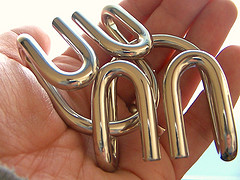
The Devil’s Claw

Standard

I was shocked.  I was thrilled.   And then, I was completely ticked off. 

I’ve had this puzzle for almost a year.   It’s called the Devil’s Claw.  

You can get these at any Barnes and Noble and this one is rated “Challenging”.   The key is to get the darned thing apart into the two pieces.  I’ve tried.  My wife has tried, my daughter has tried,  my son had tried, my son’s friend has tried, unsuspecting party goers and holiday revelers have tried as I’ve begged many to just “ give it a go” and figure out a way to get the Devil’s claw apart.   

I like the puzzle.

It represents something too, this puzzle.  It must be defeated because well, it just has to be.  Hanayama, the company that makes the puzzle, specializes in recreating these puzzles from the 19th century and knows that there are thousands of people like you and me who need this type of challenge.     We tackle puzzles every day at work, but we sometimes want  more.  

At exactly 9:47 pm, I was sitting in the Man Cave (yep, I got one of those).   The Discovery channel was on (something about submarines), the laptop open and email up, a Bud Lite nearby too close to empty and as I was apt to have,  the Devil’s Claw was in my hands.

And……then…..

It came apart.  One piece in my left hand ….and one piece in my right hand. 

I was shocked.  I was thrilled.   And then, I was completely ticked off.   

I jumped to my feet.   Finally, after so much time had passed, I had defeated the Devil’s Claw.    The only problem was, as I began to head upstairs to exclaim to my wife that I had conquered the devil himself,  I realized that I had no idea how I did it.   I had taken it apart but had no idea how.  None. 

That was not good.  That was really not good.  That made me angry.  And then as I paused, it made me realize how often this happens.

I wanted to share how had succeeded.  I needed to share how I succeeded.  I actually needed to know how I did it.

When you succeed today at work, perhaps landing a colossal sale, are you absolutely sure how you did it?   Do you know exactly what steps you took, what process, what angles, what words, what perspective you took to make that success happen?

What exactly was the way in which you were able to take your Devil’s Claw apart?  When your colleagues, boss or spouse ask “How did you do it?”   Can you respond in a specific way?

You need to.  And often, too often, it isn’t easily explained.

Over the years, I have heard many success stories, so many difficult yet successful stories in which a sale was made, a solution solved, a customer indebted for life to you because of what you did.   And over the years, the how is often lost.

The how gets buried in the “It was magical, they ended up buying the whole suite!” or the “I just went with it” or the dreaded “because I’m a good salesperson.”  The how is forgotten.

Even the “I kept probing until I discovered” or “I wouldn’t take “no” for and answer” or the “I just knew we had what they needed” is akin to that playing mindlessly as I did with the Devil’s Claw in my lap and having it fall apart in my hands.

Success without knowing how, is not success, it is Random Achievement.  Random Achievement isn’t something you or I want.  What we want is success that we can understand and explain.  Success that is understood in minute detail is repeatable and wonderful.

Every manager, sales leader or marketer out there should be asking the questions of the successful salesperson about that successful sale and exactly what happened.   Don’t settle for the vague answers or the generalizations.  Salespeople who are successful may or may not be aware of how they accomplished the feat; (I know that years ago as a salesperson, it took me time before I was consciously aware of how I succeeded).  Your job as a leader is to delve deep into that space and “CSI” the event giving the salesperson and the respective populace the recipe for achieving this specific success. 

Random Achievement is great at the time, but it is no longer random when it falls identifiably upon people with some consistency.   The Devil’s Claw for me was a Random Achievement.   It did not have to be.  I’ve been working on that puzzle for nearly a year. 

Watch closely.  Watch how.   

I went to Barnes and Noble yesterday and got two more puzzles, both more difficult supposedly than the one I unknowingly conquered.  

The devil made me do it.   But this time, I’ll be watching. 

Till next time,

Grow The Business.

Mark

Ugh! The World Cup Soccer Sales Approach

Standard

I figured out why some of our sales efforts don’t work so well.   We sometimes use the World Cup Soccer Sales Approach.  

I tried watching the World Cup over the weekend.  I did.  I watched England vs. USA and Germany vs. Australia.    I was annoyed, confused and bored.    I walked away.  

Thankfully those 5 hours I wasted made me realize that the World Cup Soccer Sales Approach is dangerous.  Use it on prospects and customers and they too will become annoyed, confused, bored and walk away.   

In order to see if you suffer from using the WCSS approach let’s take a look at the nasty 3 step problem that is World Cup Soccer and its sales counterparts.

Step 1Annoy Your Audience.  The trumpets have got to go.  That incessant drone (and it really does sound like angry bees) is all that you hear.  It borders on inane.   This is white noise of the worst kind; white noise that is too loud and won’t go away.   White noise like this can be damaging to sales especially when we cold call (or warm call) customers or prospects poorly.   For those 10, 30 or 120 seconds of you spouting your benefits, or “our possible fit” and other drivel like “I can save you time and money” these folks hear blaring in ear and brain self talk like “How do I get rid of you!”, “Can I just hang up???…” I have got real work to do!!.   Annoying white noise is a big deal especially when practicing interruption marketing or sales.

Step 2 : Confuse Your Audience:   I’m not following what these guys are doing with the ball.  Moving forward, passing backward 3 times, moving forward, and passing backward again and again.  And offsides?; impossible to figure out even in replay.    How often does your client or prospect get bounced or passed around to someone and they don’t understand why either?  How often, just when your client thinks they are moving ahead, does she have to tell her story repeatedly to customer service, technical support, an account manager or in chat?  Confusion causes tension and tension stops sales.

Step 3:  Bore Your Audience:   This is the worst because if you can somehow get past the trumpet blaring white noise and figure out the confusing way to work with your business then it all goes for naught if you are downright boring.  I heard a joke over the weekend that that soccer call “gooooooooaaaaaaaaaaallllllll!!!” is really an alarm clock for the sound asleep American on the couch.  My wife was sound asleep watching soccer with me (her last utterance something like.. “nothing is…happening…” ).  And while the commentators never yelled “goal” like in the joke to wake her, the point is not lost.  Boring does not sell.   If your business is unremarkable (especially after that first sale) then your clients and prospects will walk away.   

Till next time,

Grow The Business.

Mark
You Got Facts? So What?

Standard

It’s not the size of your knowledge that matters, it’s what you do with it that counts. 

You see, facts are getting less and less valuable every day.  They are just too easy to come by.

I saw two people sitting at a bar the other night playing that trivia game thing; you know the one you pump the quarters into and try and get the highest score.  One of them had an IPhone.    Fastest animal?  No problem, just Google it.  Superbowl X Champion?  That’s easy…Badda -Bing it.  Tallest skyscraper?…Yippy- Yahoo it.  

Game over.   That was fun.   Game means nothing now and so does your score.

Got a new video game for your kid?  Most 12 year olds go online, get the Cheatin’ facts and get the game codes.   Game over.   Good for you that you defeated Tyranna KingZilla, means nothing to me (and really to anybody else either).

Used to be that knowing a lot of facts nobody else knew actually meant something.  Meant you were smart.  Meant you had value.   Not anymore.

If you are the Keeper of the Knowledge, the Knower of All Things or the Encyclopedia of Vital Stuff, good for you except your days of being truly valuable are numbered.  

And that’s OK. 

Knowing facts or having knowledge all by itself had its day, but that was so yesterday.  

  • You’re a plumber who knows how to fix a leaky faucet.  So what? In a heartbeat I can go to ehow.com ( http://www.ehow.com/video_15854_fix-leaky-faucet.html ) and get all kinds of facts by watching a video on how to fix my faucet.  You’ll never get my call.
  • You’re a sales rep who knows every product, every process and every procedure ever created.  So what?  If you are up against someone who has great sales skills and a good search engine, you’ll get the steak knives and he’ll get the Cadillac.


It’s not about you knowing stuff no one else knows anymore.   Your customers and your competition can know pretty quickly what you know as far as facts go.  It’s about having the skills to do something with the facts.  The skills and applications and ability to seamlessly and proactively use facts to market better, to sell better, to strategize better and to differentiate you from just being a repository of those darn facts. 

That’s a good thing.

People and businesses that can do those kinds of things well will grow in value. 

So chill a bit about the facts (you can get those so much more easily now) and work on the skills.   That’ll make you stronger and nobody for a long time (maybe never) is going to say “so what?” to that.    

Till next time,

Grow The Business.

Mark

Still The Luckiest Man In The World

Standard

I hope you don’t mind, because on Sunday, it will be one year.

So I apologize, no post today on anything that will help you grow the business.  This one is for my wife.  She’s a blog subscriber too. 

I thought about writing something new this year but then I looked at what I posted with all of you last June 11th and thought not.  You see, when I read it again every word is true, except now I truly know what I thought I knew then;  

Susan, I am still the luckiest man in the world.   

*****

Originally published June 11th, 2009


The Luckiest Man In The World


I admit I’m not an expert on marriage and have the track record to prove it.   But my guess is that you’ll be alright if;

You marry someone who feels it is more important to be there for others who have less or are in need, than to be there for everyone.

You marry someone who works hard, never misses a day, and defines her performance only by the happiness of her customers.

You marry someone who when she first met your child of 6 years old, knelt down, looked at him eye to eye, said hello and then gave him a big hug.

You marry someone who loves with all her heart, the movies from the 30’s and 40’s because they always have happy endings.

You marry someone who cries tears of joy almost daily just upon hearing that a total stranger had a baby or if she happens to she see two toddlers walking, holding hands.

You marry someone, a single mother who from her teenage years has raised a beautiful person in her daughter with the crazy belief that “I want to raise her not to be like me”.

Susan, your daughter is just like you and it is the greatest gift you have given her.  My son has known you nearly half of his life and I swear, he loves you as much as I do. 

Saturday, I get to marry you.

I think we are going to be more than alright.  It’s a trite statement but there is a reason someone came up with it.  Now, I know.

I am the luckiest man in the world. 

Till next time,

Grow The Business.

Mark

*******

Mark McCarthy
Director, Sales Competency and Training

Deluxe Corporation
500 Main Street, Groton, MA 01471
Phone: (978) 449-3429  
email: mark.mccarthy@deluxe.com

Visit my Internal Blog at  http://blogs.deluxe.com/Mark/

Visit my External Blog at https://growthebusiness.wordpress.com/

Twitter at   http://twitter.com/GrowTheBusiness

Interrogation Is Not A Sales Strategy

Standard


You do it all the time.

When online, if you make me fill out anything more than my name and email address just so I can just learn more about your company or your product; then you believe that interrogation is a sales strategy.    And I will summarily go sign up for somebody else’s Webinar at their website and grow their business instead of yours.

When at the do it yourself superstor you ask me (after I politely ask you where something is…) questions like “If you were going to remodel your garage or your kitchen, which one would it be?” and without even taking another breath add, “And if it was the kitchen, would you have to move the stove or the sink?”; then you believe that interrogation is a sales strategy.    And the next time, when I need drywall screws or darned near anything else, I will go somewhere else. (His name was Steve and I kind of feel bad he was trained like that- seemed like a nice kid.)

When I call to order more business cards and you pepper me with six questions about my small business without so much as offering an ounce of proof that you even understand small business; then you believe that interrogation is a sales strategy.    And I will not buy another product from you.

Interrogation can be many things, but it is decidedly not,  a sales strategy.

Quit it.

Till next time,

Grow The Business.

Mark

Perfect Games in Sales & Marketing

Standard

In baseball there is all the rage about perfect games this year.  But it’s not whether there have been two or three perfect games (I say 3) this year that strikes me.   What occurs to me is the tremendous advantage baseball has to know what perfection looks like.

In baseball, you know what a perfect game should look and feel like when you get there.   You can envision the 3 hour battle, the tension rising, the crowds standing all throughout the 9th inning and the euphoric on field celebration as the 27th consecutive batter is retired. 

In Sales and Marketing you aren’t sure what that perfect campaign or sale looks or feels like whether you are a big company, small business   or sell for yourself.   Wouldn’t it be great if we knew what a perfect sales or marketing campaign looked like?

If you knew, you could better build the path, the processes and the tools you’ll need to get there.  And when we you see a vision of perfection you can measure better your performance in sales and marketing comparatively.

Don’t take the easy way and say a perfect game in a sale or a marketing campaign would exceed revenue results, would be done ahead of schedule and under budget.  That’s not a perfect game.  Here’s the scorecard for real perfection.

A Sales/Marketing Perfect Game

1st Inning:  You took a big risk.  You targeted a new market.  This campaign, this sale is a game changer; no tiny incremental move here; you are going for it.

2nd Inning:  Before you’ve sold anything, you’ve ‘sold” everyone on your team first.  You get the Manager on board, your colleagues, your teammates and you’ve got them all ready to play like hell for you.  No lone ranger here, the most brilliant sales people and marketers don’t do it alone.

3rd Inning:  You are obsessed with differentiation.   99% of us have at least 1 competitor.  In this perfect game your lead story sets you apart in such a way that you create a buzz offline and online; just like a high and tight fastball buzzed inside gets attention.

4th Inning:  You are obsessed with credibility.  The marketplace today is trust starved.  The internet is the gathering place for pseudo soothsayers and the volume of baseless advice is endless.   In this perfect game you pull out all the stops, pick up the best radar gun and prove how credible you and your company are. 

5th Inning:  You focus on your prospect or your targeted market’s time.  It’s scarce and more valuable than ever.  The perfect campaign respects this.  The perfect campaign invests in this.  Maybe even pays the prospect just for their time.  Knee jerk spray and pray selling or marketing is the bane of the 6 hour, 9 to 8 game that is far away from perfect and creates indifferent fans.

6th   Inning:  This perfect sale doesn’t hit the prospect or the market just at the right time, no siree.  This perfecto takes   perfectly normal consumers or businesses that have no interest in what you have to sell, have no need, no desire and no problem just waiting to be solved and instead, creates interest where there is none.   If you can do that, that is really something.  This inning is where heads start to really turn and focus.

7th inning:  The 7th inning Stretch where the marketer and the sales person are getting real interest but instead of closing and/or pushing shopping carts; you are in it for the long haul.  You stretch the closing of the sale.  You ache to personalize the solution, the consultation.  You tailor your product for each client as this is a relationship you want beyond the first sale.  You want to build raving fans.

8thinning:    No need for a closing (or a closer for that matter).   The perfect sale or marketing campaign doesn’t need discounts, special offers, expiration dates and the like.  This perfect game needs none of that.  The visitors sign up in droves, the prospects ask for not just 1 but 2.  They leave a voicemail on your cell that they want to start on Monday. 

9th Inning:  Here is where the perfect games in sales and marketing matches that of baseball.  It’s a celebration.  Nobody is surprised (because they’ve all been really watching since the 6th inning.)  It’s a moment for posterity; everyone remembers where they were when that campaign or that sales rep delivered like no other.

You can still win lots of games without pitching a perfect one but at least now you know what one looks like in sales and marketing.   And just because of that, my guess is you’ll start playing better right away. 

Till next time,

Grow The Business.

Mark

Pssst! Check These Out

Standard

I’ve got some uncommon sales tips for you.   Not sure why you don’t hear much about them; they really work.  

Learn From Radio Commercials:  These are some of the best guides for how to create interest and sell.  A radio ad has just 30 seconds (or less) to grab our attention and drive you to action and/or make an impression you won’t forget.  Often your sales people have just about the same amount of time.  Next time you sit in the car, really listen and break the commercials down.  You will hear concepts likely in this order; credibility, commonality, benefits, applications and testimonials mixed with humor, contact info and perhaps a jingle.  I guarantee you’ll hear something you can steal by listening, really listening, to radio commercials.  Sales managers, bring a radio to your next huddle, listen to a live commercial and break it down with your team ( I’ve done this for real and it makes a huge impact with your staff) or perhaps gather folks around your car with speakers blaring just before the shift starts- it will be worth it.

Lower Your Voice:. It’s a given in the electronic media and social psychology research shows that the lower the pitch of your voice (even relative to your normal speaking voice pitch); the more credible the message sounds.  Think of this; have you ever heard anything other than a lower pitched voice do commercials or voiceovers on the radio? (This includes female voices, which like males on radio, are more likely to be lower in pitch than the average person of their respective gender). So pick your critical sales phrasing appropriately and lower the tone in just the right places.  And the next time you are justifying why you need a raise, keep that voice nice and low…

Stop Selling One Day Per Week (or more)   Have an existing customer base?  Spend one day per week visiting / calling out and just overtly thanking your clients.  That means more than just saying “Thank You” of course, but the specifics I’ll leave to you.  You could include an article too about how the local demographics are changing saying “I was thinking of you” or drop off a branded promo item with your sincere acknowledgement of their 7 years with your company.  You get the idea. This day will leave one heck of an impression that will lead to more sales and referrals than you can imagine.  

Till next time,

Grow the Business.

Mark

5 New Rules For Business Writing

Standard

Let’s be real.   People don’t read as much as they used to. 

They actually read more. 

It’s a texting crazy world.   It’s a blogging crazy world.  It’s a facebookin’ crazy world.  Just look at your kids or your spouse or even your Mom and tell me I’m wrong that we are reading and writing more than ever before. 

Who would have thought  that reading and writing would be so popular today?  Who would have thought 20 years ago that that personal email and the personal letter would still be so much alive when it came to communicating to customers and prospects?  

You’ve got to write to your customers.  Clients expect it now; they even prefer it sometimes.  But the world is changing and so are the writing rules.   Here are 5 you need to know:  

Quit Sounding Like Your Brochure.   A letter from a person (you), should sound like a letter from the person (you).  And a professional person mind you, not a buddy- chummy- BFF one.  In your emails or letters, lose the “The 3 major benefits of our product are….”  Change it to “I’ve noticed three ways customers use this service to get the most out of it…”  The easiest way to think about this is to bring the “I’s”, the “I’ves and the “me’s” back to customer correspondence.   Save the “We’s, the “Ours’” and “Us’s” for the brochure.  This letter or the email is from you isn’t it?  

Don’t Screw Up.   OK, so this one is not so new; but the pain you get is a new kind of pain. It’s quick and severe.  Mistakes in spelling or punctuation in the past might have been “cute” or could even make you look “human” (I remember in the early 90’s purposely indenting something too much so the prospect wouldn’t think this was a template letter!) Today, you make a spelling mistake and it’s a reason to delete or trash your email.  Why? Because all the customer has to do is click twice and she can find your competition who actually knows how to spell.   Don’t give her a reason to look.

Don’t Lose Your Sales Process.    This one drives me crazy.  If you weren’t betting on closing the sale on your first phone call or visit, why does your email or letter try to?  Why does it have the link to “sign up” or have the complete pricing listed?  Sales are like dating; you rarely marry the girl you meet 20 minutes after you meet them.  A (marriage) proposal inside of 2 minutes in a letter and you’ll rightly get slapped in the face (and deleted or trashed). Remember your prospect “hears” you as they read; stay with your trusted sales process, don’t change it from real life or a real phone call. 

Long Paragraphs Kill.    I love Jack Falvey (you can love him too if you go here http://www.falvey.org).  But jeepers criminy, every morning when I get his post I cringe.   It’s just a big ol’ block o’ words; One paragraph.  One looooonnnnggg paragraph.  Maybe it’s his brand or his style but I sigh, I shrug and then I ball up some energy, raise my head and bloody well decide if I want to read this thing.   And honestly, half the time I don’t.  We need the visual breaks; they are the eye candy of writing.  There is a reason Tweeting at no more than 140 characters is popular.  Break it up; think space.

Lose Your Pontificating Signature Quote.  I know you love Sartre or Brecht or Roosevelt or Einstein; good for you.  No one’s opinion but yours though belongs in a business letter or email to a customer.  You’ve messing with fire if you dangle a quote under your name or signature as your personality and your passion should have been in the content above the quote: not here under your name. You haven’t a clue if your reader cares or will be offended.   The worst of course are the people that write “Think twice about printing this email….”.  OK, I will.  I was going to print your awesome letter it and share it with my husband or my wife or my family or colleagues and consider you as a partner, but instead I’ll delete you.  How dare you preach to me, I don’t even know you!  Please don’t pontificate your views about green or blue or red or life or death or taxes in customer correspondence.  Save it for your blog 🙂

Till next time,

Grow The Business.

Mark

Remembrance & The Best Advice Ever

Standard

I had my moments this weekend.  

Moments when I should have personally used the best advice ever, but forgot.  When I did remember the advice, the setting made me feel a little embarrassed that I had forgotten it. 

The advice is grand, and its use can be grand.  Memorial Day has just passed and the men and women whose sacrifice allows us to do and be what we are today applied this advice in spades.  The advice is glorious and powerful when applied to issues large or small.  Here it is:

 It’s not what happens to you that matters most, but it’s how you react to what happens that does.

Dozens claim to have authored the advice but no matter as in this case, it’s the advice that should stick; not the source.

My moments this weekend were trivial compared to soldiers who chose and choose to react to war by joining the forces that protect this country.  But that’s OK because my reactions though significantly less impactful than our soldiers reactions,  influence my children, my wife, my colleagues, my friends, my customers and my work.  So truly, how I react to things that happen matters more than what actually happens to just me, as others are always involved. 

When I saw the flags lining the street on Saturday and when I saw Boy Scouts planting flags by each veteran’s grave, I remembered that best advice ever. 

I can get bad news, a bad report or even a bad look from a stranger and choose to anger, to revenge, to feel victimized.  Or I can get bad news and chose to be thoughtful, be assertive, to be selfless.  I don’t always control what happens but I sure as hell can control the reaction.

I pledge to do better at applying that advice beginning today, in honor of those who did it so well before me.  How about you?     

Till next time,

Grow The Business.

Mark

You Don’t Know, Jack

Standard

“Well Jack, that may be real, but it sure as hell isn’t interesting.”

Interesting how an insult Jack Nicholson received over 40 years ago is so relevant today.  The insult was one he deemed the best piece of advice he’d ever gotten. (See extras in The Shining DVD at Netflix)

I think it is great advice for us too.

The “insult turned advice” as Jack puts it, came from a film director back in the 60’s after reviewing Dailies in which Jack (like many actors of the period), performed scenes with great effort on being as “real” as possible on screen.  Hey, it was the 60’s and “being real” was where it was at. 

“Well Jack, that may be real, but it sure as hell isn’t interesting”

If you are in sales or marketing (and the reality is, we all are), this advice is perfect and a little more of what we need these days.    You can be “real” all you want with customers/prospects; stay the course, keep the message clear and lay out the values.  You can even do it like you’ve never done it before using YouTube or Twitter or WebEx or whatever, but truth is since everyone else is doing it that way, and you are largely just changing your mediums,  that may be just a different kind of real.

 And while that might be a different real, it sure as hell isn’t interesting.

And that’s a problem.  With all the clutter and all the short attention spans and all the competition, we should worry a lot less about being real, and start to get more interesting.

When you are selling for real, skip the “real”.  Sell with a story.  Sure, you can lay out the benefits of your product, it’s solving a problem or driving more clicks, or how that new logo can create a lasting impression with a prospect, or you can be interesting and start a “mental movie” in the customer’s mind by saying the same thing but with a story.    A story about the prospect that followed the van with the super cool new logo just to see where the business was who owned it, is way more interesting than the customer focus group data about changing a logo.  The stories are out there, and they are compelling.

When you are selling for real, skip the “real”.  Sell with emotion.  Nicholson learned “real” doesn’t work on the big screen, but ‘interesting” does.  Make a big deal with whatever it is you are selling and let’s hear the passion in your voice or on your video.  Let’s hear the energy about your 5 favorite products as you describe them to your client in breathless, halting, excited tones.   Go big with emotion and storytelling when selling, it intrigues and it works.

Assume that camera is filming live as you converse with your client or your media is making its first impression.   Your audience is critiquing you. 

Don’t be real.  Be interesting.

Till next time,

Grow The Business.

Mark