
Pretend You Have No Choice

Standard

When we go to a new product training we have no choice but to learn because if we don’t, we won’t know the prices, the models, the features or the options available.  And we’ll sound unprepared and unprofessional in front of the customer.  

When we go to a systems or CRM training we have no choice but to learn because if we don’t, we won’t be able to enter an order, research customer history, look up a price or navigate anywhere.  And we’ll sound unprepared and unprofessional in front of the customer.

But somehow when we go to a sales skill training, or a negotiation training, or a customer service training, we think we have a choice to learn or to not.  Somehow because our system won’t lock up or we don’t fumble for the right pricing or we always find the history we are looking for, we think this kind of training is optional to apply.

Truth is if we choose not to learn and apply in these types of trainings we will sound woefully unprepared and unprofessional in front of the customer.

More and more today, what you say to a customer and how you say it is critical to differentiating you and your company from others.  Remember that customers today need less and less human interaction to get information; what they need and get from our live conversations however,  is the experience and that is a big deal. 

Pretend you have no choice when it comes to learning in these types of soft skills trainings.  Just because the path forward after the class doesn’t change and force you into learning the topic doesn’t negate its value.       

Till next time, 

Grow The Business.  

Mark

Bad Service? Maybe You’re The Problem

Standard

I’ve been watching you.

Yeah, that chill you got last Saturday while shopping was probably me. 

And some of you folks are no treat to deal with. 

But before I get into that, let’s talk about Bad Service.  It gets all the press.  Bad service gets Twitter all atwitter as people write about their bad experiences at Best Buy or with HP or at the local Mini Mart.    Bad service gets all the chatter in the hallways and the lunchrooms as people talk about the rude waitress or the incompetent accountant or the indifferent business owner.

But I’ve been watching you.  And it often takes two to tango.    

A big part of the problem with Bad Service may be you.

I saw you at the check out line in Costco when you didn’t even think to put those heavy items in your cart with the bar code facing up or god forbid, hoist them up on the belt.  Nope, that’s not your job.  Then I saw you get all snippy thinking the cashier lady (who weighed all of about 90 pounds) was being too rough with your stuff as she struggled mightily to lift items so she could scan.   I blame you for that Bad Service experience.  

I saw you never even look up at the gas station clerk as you ignored her outstretched hand and instead placed your $20 bill on the counter for her to retrieve it.  She responded in kind and placed your change right back on the counter where you dropped your cash.  I saw that look as you clumsily collected your bills, quarters and pennies.  I bet you complained about that experience later but I blame you for that Bad Service experience.  

I saw you tell that animated story to your husband about how you showed up “wicked early” Monday morning at the Auto repair shop to get that muffler fixed (early for you being 8:30 am I guess…) and how ticked off you were that “they couldn’t tell me how long it would take” and that you had “to call back like at 1pm and it still wasn’t done!”.   I blame you for that Bad Service experience.

My guess is that a lot of you see this kind of thing happening too.   And maybe it’s not just at the store.  Maybe you see it happening at work.  Bad Service at work gets a lot of attention too.  But maybe people who say they are getting Bad Managing or Bad Teamwork or Bad Advice aren’t totally blameless.   Maybe we should take a closer look at all those “Bad Service” claims altogether.  

Here’s watching you.

Till next time,

Grow The Business.

Mark

The Devil’s Claw

Standard

I was shocked.  I was thrilled.   And then, I was completely ticked off. 

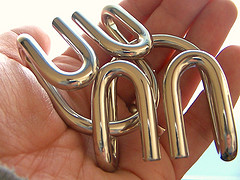
I’ve had this puzzle for almost a year.   It’s called the Devil’s Claw.  

You can get these at any Barnes and Noble and this one is rated “Challenging”.   The key is to get the darned thing apart into the two pieces.  I’ve tried.  My wife has tried, my daughter has tried,  my son had tried, my son’s friend has tried, unsuspecting party goers and holiday revelers have tried as I’ve begged many to just “ give it a go” and figure out a way to get the Devil’s claw apart.   

I like the puzzle.

It represents something too, this puzzle.  It must be defeated because well, it just has to be.  Hanayama, the company that makes the puzzle, specializes in recreating these puzzles from the 19th century and knows that there are thousands of people like you and me who need this type of challenge.     We tackle puzzles every day at work, but we sometimes want  more.  

At exactly 9:47 pm, I was sitting in the Man Cave (yep, I got one of those).   The Discovery channel was on (something about submarines), the laptop open and email up, a Bud Lite nearby too close to empty and as I was apt to have,  the Devil’s Claw was in my hands.

And……then…..

It came apart.  One piece in my left hand ….and one piece in my right hand. 

I was shocked.  I was thrilled.   And then, I was completely ticked off.   

I jumped to my feet.   Finally, after so much time had passed, I had defeated the Devil’s Claw.    The only problem was, as I began to head upstairs to exclaim to my wife that I had conquered the devil himself,  I realized that I had no idea how I did it.   I had taken it apart but had no idea how.  None. 

That was not good.  That was really not good.  That made me angry.  And then as I paused, it made me realize how often this happens.

I wanted to share how had succeeded.  I needed to share how I succeeded.  I actually needed to know how I did it.

When you succeed today at work, perhaps landing a colossal sale, are you absolutely sure how you did it?   Do you know exactly what steps you took, what process, what angles, what words, what perspective you took to make that success happen?

What exactly was the way in which you were able to take your Devil’s Claw apart?  When your colleagues, boss or spouse ask “How did you do it?”   Can you respond in a specific way?

You need to.  And often, too often, it isn’t easily explained.

Over the years, I have heard many success stories, so many difficult yet successful stories in which a sale was made, a solution solved, a customer indebted for life to you because of what you did.   And over the years, the how is often lost.

The how gets buried in the “It was magical, they ended up buying the whole suite!” or the “I just went with it” or the dreaded “because I’m a good salesperson.”  The how is forgotten.

Even the “I kept probing until I discovered” or “I wouldn’t take “no” for and answer” or the “I just knew we had what they needed” is akin to that playing mindlessly as I did with the Devil’s Claw in my lap and having it fall apart in my hands.

Success without knowing how, is not success, it is Random Achievement.  Random Achievement isn’t something you or I want.  What we want is success that we can understand and explain.  Success that is understood in minute detail is repeatable and wonderful.

Every manager, sales leader or marketer out there should be asking the questions of the successful salesperson about that successful sale and exactly what happened.   Don’t settle for the vague answers or the generalizations.  Salespeople who are successful may or may not be aware of how they accomplished the feat; (I know that years ago as a salesperson, it took me time before I was consciously aware of how I succeeded).  Your job as a leader is to delve deep into that space and “CSI” the event giving the salesperson and the respective populace the recipe for achieving this specific success. 

Random Achievement is great at the time, but it is no longer random when it falls identifiably upon people with some consistency.   The Devil’s Claw for me was a Random Achievement.   It did not have to be.  I’ve been working on that puzzle for nearly a year. 

Watch closely.  Watch how.   

I went to Barnes and Noble yesterday and got two more puzzles, both more difficult supposedly than the one I unknowingly conquered.  

The devil made me do it.   But this time, I’ll be watching. 

Till next time,

Grow The Business.

Mark

You Got Facts? So What?

Standard

It’s not the size of your knowledge that matters, it’s what you do with it that counts. 

You see, facts are getting less and less valuable every day.  They are just too easy to come by.

I saw two people sitting at a bar the other night playing that trivia game thing; you know the one you pump the quarters into and try and get the highest score.  One of them had an IPhone.    Fastest animal?  No problem, just Google it.  Superbowl X Champion?  That’s easy…Badda -Bing it.  Tallest skyscraper?…Yippy- Yahoo it.  

Game over.   That was fun.   Game means nothing now and so does your score.

Got a new video game for your kid?  Most 12 year olds go online, get the Cheatin’ facts and get the game codes.   Game over.   Good for you that you defeated Tyranna KingZilla, means nothing to me (and really to anybody else either).

Used to be that knowing a lot of facts nobody else knew actually meant something.  Meant you were smart.  Meant you had value.   Not anymore.

If you are the Keeper of the Knowledge, the Knower of All Things or the Encyclopedia of Vital Stuff, good for you except your days of being truly valuable are numbered.  

And that’s OK. 

Knowing facts or having knowledge all by itself had its day, but that was so yesterday.  

  • You’re a plumber who knows how to fix a leaky faucet.  So what? In a heartbeat I can go to ehow.com ( http://www.ehow.com/video_15854_fix-leaky-faucet.html ) and get all kinds of facts by watching a video on how to fix my faucet.  You’ll never get my call.
  • You’re a sales rep who knows every product, every process and every procedure ever created.  So what?  If you are up against someone who has great sales skills and a good search engine, you’ll get the steak knives and he’ll get the Cadillac.


It’s not about you knowing stuff no one else knows anymore.   Your customers and your competition can know pretty quickly what you know as far as facts go.  It’s about having the skills to do something with the facts.  The skills and applications and ability to seamlessly and proactively use facts to market better, to sell better, to strategize better and to differentiate you from just being a repository of those darn facts. 

That’s a good thing.

People and businesses that can do those kinds of things well will grow in value. 

So chill a bit about the facts (you can get those so much more easily now) and work on the skills.   That’ll make you stronger and nobody for a long time (maybe never) is going to say “so what?” to that.    

Till next time,

Grow The Business.

Mark

Interrogation Is Not A Sales Strategy

Standard


You do it all the time.

When online, if you make me fill out anything more than my name and email address just so I can just learn more about your company or your product; then you believe that interrogation is a sales strategy.    And I will summarily go sign up for somebody else’s Webinar at their website and grow their business instead of yours.

When at the do it yourself superstor you ask me (after I politely ask you where something is…) questions like “If you were going to remodel your garage or your kitchen, which one would it be?” and without even taking another breath add, “And if it was the kitchen, would you have to move the stove or the sink?”; then you believe that interrogation is a sales strategy.    And the next time, when I need drywall screws or darned near anything else, I will go somewhere else. (His name was Steve and I kind of feel bad he was trained like that- seemed like a nice kid.)

When I call to order more business cards and you pepper me with six questions about my small business without so much as offering an ounce of proof that you even understand small business; then you believe that interrogation is a sales strategy.    And I will not buy another product from you.

Interrogation can be many things, but it is decidedly not,  a sales strategy.

Quit it.

Till next time,

Grow The Business.

Mark

Perfect Games in Sales & Marketing

Standard

In baseball there is all the rage about perfect games this year.  But it’s not whether there have been two or three perfect games (I say 3) this year that strikes me.   What occurs to me is the tremendous advantage baseball has to know what perfection looks like.

In baseball, you know what a perfect game should look and feel like when you get there.   You can envision the 3 hour battle, the tension rising, the crowds standing all throughout the 9th inning and the euphoric on field celebration as the 27th consecutive batter is retired. 

In Sales and Marketing you aren’t sure what that perfect campaign or sale looks or feels like whether you are a big company, small business   or sell for yourself.   Wouldn’t it be great if we knew what a perfect sales or marketing campaign looked like?

If you knew, you could better build the path, the processes and the tools you’ll need to get there.  And when we you see a vision of perfection you can measure better your performance in sales and marketing comparatively.

Don’t take the easy way and say a perfect game in a sale or a marketing campaign would exceed revenue results, would be done ahead of schedule and under budget.  That’s not a perfect game.  Here’s the scorecard for real perfection.

A Sales/Marketing Perfect Game

1st Inning:  You took a big risk.  You targeted a new market.  This campaign, this sale is a game changer; no tiny incremental move here; you are going for it.

2nd Inning:  Before you’ve sold anything, you’ve ‘sold” everyone on your team first.  You get the Manager on board, your colleagues, your teammates and you’ve got them all ready to play like hell for you.  No lone ranger here, the most brilliant sales people and marketers don’t do it alone.

3rd Inning:  You are obsessed with differentiation.   99% of us have at least 1 competitor.  In this perfect game your lead story sets you apart in such a way that you create a buzz offline and online; just like a high and tight fastball buzzed inside gets attention.

4th Inning:  You are obsessed with credibility.  The marketplace today is trust starved.  The internet is the gathering place for pseudo soothsayers and the volume of baseless advice is endless.   In this perfect game you pull out all the stops, pick up the best radar gun and prove how credible you and your company are. 

5th Inning:  You focus on your prospect or your targeted market’s time.  It’s scarce and more valuable than ever.  The perfect campaign respects this.  The perfect campaign invests in this.  Maybe even pays the prospect just for their time.  Knee jerk spray and pray selling or marketing is the bane of the 6 hour, 9 to 8 game that is far away from perfect and creates indifferent fans.

6th   Inning:  This perfect sale doesn’t hit the prospect or the market just at the right time, no siree.  This perfecto takes   perfectly normal consumers or businesses that have no interest in what you have to sell, have no need, no desire and no problem just waiting to be solved and instead, creates interest where there is none.   If you can do that, that is really something.  This inning is where heads start to really turn and focus.

7th inning:  The 7th inning Stretch where the marketer and the sales person are getting real interest but instead of closing and/or pushing shopping carts; you are in it for the long haul.  You stretch the closing of the sale.  You ache to personalize the solution, the consultation.  You tailor your product for each client as this is a relationship you want beyond the first sale.  You want to build raving fans.

8thinning:    No need for a closing (or a closer for that matter).   The perfect sale or marketing campaign doesn’t need discounts, special offers, expiration dates and the like.  This perfect game needs none of that.  The visitors sign up in droves, the prospects ask for not just 1 but 2.  They leave a voicemail on your cell that they want to start on Monday. 

9th Inning:  Here is where the perfect games in sales and marketing matches that of baseball.  It’s a celebration.  Nobody is surprised (because they’ve all been really watching since the 6th inning.)  It’s a moment for posterity; everyone remembers where they were when that campaign or that sales rep delivered like no other.

You can still win lots of games without pitching a perfect one but at least now you know what one looks like in sales and marketing.   And just because of that, my guess is you’ll start playing better right away. 

Till next time,

Grow The Business.

Mark
5 New Rules For Business Writing

Standard

Let’s be real.   People don’t read as much as they used to. 

They actually read more. 

It’s a texting crazy world.   It’s a blogging crazy world.  It’s a facebookin’ crazy world.  Just look at your kids or your spouse or even your Mom and tell me I’m wrong that we are reading and writing more than ever before. 

Who would have thought  that reading and writing would be so popular today?  Who would have thought 20 years ago that that personal email and the personal letter would still be so much alive when it came to communicating to customers and prospects?  

You’ve got to write to your customers.  Clients expect it now; they even prefer it sometimes.  But the world is changing and so are the writing rules.   Here are 5 you need to know:  

Quit Sounding Like Your Brochure.   A letter from a person (you), should sound like a letter from the person (you).  And a professional person mind you, not a buddy- chummy- BFF one.  In your emails or letters, lose the “The 3 major benefits of our product are….”  Change it to “I’ve noticed three ways customers use this service to get the most out of it…”  The easiest way to think about this is to bring the “I’s”, the “I’ves and the “me’s” back to customer correspondence.   Save the “We’s, the “Ours’” and “Us’s” for the brochure.  This letter or the email is from you isn’t it?  

Don’t Screw Up.   OK, so this one is not so new; but the pain you get is a new kind of pain. It’s quick and severe.  Mistakes in spelling or punctuation in the past might have been “cute” or could even make you look “human” (I remember in the early 90’s purposely indenting something too much so the prospect wouldn’t think this was a template letter!) Today, you make a spelling mistake and it’s a reason to delete or trash your email.  Why? Because all the customer has to do is click twice and she can find your competition who actually knows how to spell.   Don’t give her a reason to look.

Don’t Lose Your Sales Process.    This one drives me crazy.  If you weren’t betting on closing the sale on your first phone call or visit, why does your email or letter try to?  Why does it have the link to “sign up” or have the complete pricing listed?  Sales are like dating; you rarely marry the girl you meet 20 minutes after you meet them.  A (marriage) proposal inside of 2 minutes in a letter and you’ll rightly get slapped in the face (and deleted or trashed). Remember your prospect “hears” you as they read; stay with your trusted sales process, don’t change it from real life or a real phone call. 

Long Paragraphs Kill.    I love Jack Falvey (you can love him too if you go here http://www.falvey.org).  But jeepers criminy, every morning when I get his post I cringe.   It’s just a big ol’ block o’ words; One paragraph.  One looooonnnnggg paragraph.  Maybe it’s his brand or his style but I sigh, I shrug and then I ball up some energy, raise my head and bloody well decide if I want to read this thing.   And honestly, half the time I don’t.  We need the visual breaks; they are the eye candy of writing.  There is a reason Tweeting at no more than 140 characters is popular.  Break it up; think space.

Lose Your Pontificating Signature Quote.  I know you love Sartre or Brecht or Roosevelt or Einstein; good for you.  No one’s opinion but yours though belongs in a business letter or email to a customer.  You’ve messing with fire if you dangle a quote under your name or signature as your personality and your passion should have been in the content above the quote: not here under your name. You haven’t a clue if your reader cares or will be offended.   The worst of course are the people that write “Think twice about printing this email….”.  OK, I will.  I was going to print your awesome letter it and share it with my husband or my wife or my family or colleagues and consider you as a partner, but instead I’ll delete you.  How dare you preach to me, I don’t even know you!  Please don’t pontificate your views about green or blue or red or life or death or taxes in customer correspondence.  Save it for your blog 🙂

Till next time,

Grow The Business.

Mark
Are You Smarter Than Your Website?

Standard

I hope so. 

I’d like to think most people are smarter than their website and quite frankly, realize they need to get even smarter.  

In a cluttered marketplace, Sales people, Service people and anyone who actually talks to customers must become the Differentiator, the Linchpin, the Trust Agent, the Service Ninja etc. etc.  to stand out from the competition.  

Before more smartness can happen, we have to make sure we are at least not dumber than our own websites.

Here’s 5 ways you can tell.

  1. If your website gives testimonials of how products helped solve a problem, grew top line revenue or saved costs, and you don’t; your website is smarter.
  2. If your website recommends a new product based on the current purchase leveraging what “other like customers buy” (like most websites do), and you don’t; your website is smarter.
  3. If your website doesn’t require a prospect to give more than a name and an email address before it sends out more information, and you do; then your website is smarter.
  4. If your website allows a customer to quickly start an order, stop midstream and check out something else, then go back to the order, and you don’t, then your website is smarter.
  5. If your website shows smiling, enthusiastic and happy people on every page, and you’re not; your website is smarter.


If you missed even one of these, start studying hard, maybe even get a tutor; expectations of you are high my friend.

Till next time,

Grow The Business.

Mark

Open Ended Questions Are Overrated

Standard

It’s like a religion almost.     

Every sales trainer since the turn of the 20th century has proselytized* that open ended questions are the key to sales success.  Those glorious questions like “How do you market your business?”, How would you describe your relationship with your current supplier?” and “How do you differentiate yourself in the market place?” are a constant in any sales training revival session.

The thought is that these types of questions will get your customer to leap to his feet and open up to you about his motivations, beliefs and values.

Except when they don’t.   The reality is that open ended questions are effective when there is already a good degree of trust established.  Open ended questions asked when trust is low can feel intrusive and just too much work to answer.  Both of these feelings by the way, shut down the sales process.

Here’s why it happens.  When you ask,   “I’m curious, how do you market your business?”  The client often thinks “Who the heck are you asking me that?” (The client rarely says this out loud, but rather will insert “brush off” language like “I’m really happy with my current supplier”).   The client could think as well “Gee, that’s complicated and you know what?, I’ve got work to do”.  Both of these reactions are the result of an unbelieving, untrusting audience.   

There’s a better way to get at the same information when trust is low.

Here’s how:  Say “I’m curious, is the business marketed online, offline or both?”   Think psychologically why this makes more sense:

  1. You took the “you” and “your” out of the question.  When trust is low a question about how you do something (especially something important like “marketing”) is a little too personal.  By saying “is the business marketed…” defers to something that, while it may be close to the client’s heart, is an it and not a you. 
  2. You gave options like “marketed online, offline or both?”.   Every Malcolm Gladwell Blink reader knows that options help decisions to be made and ideas to be chosen.   Wide open questions with no options, especially in this harried, rushed world, can stop communication altogether.  If the client has choices of responses, they are more likely to respond.  


So here’s the message.  Take your list of open ended questions and ask yourself a closed ended one before you use them. “Does the client/prospect trust me or my company enough to be asking these questions this way?” If the answer is “no” or “I don’t know”, take the “you” out of the question and add options to choose from. 

Till next time,

Go Forth and Grow The Business.

Mark

* Yeah! I can knock this off my “Bucket List” now. I always had a dream to use “proselytize” in a blog!

8 Minutes Ago

Standard

A lot of bad things happen 8 minutes ago.  One in particular, is really bad.   But don’t worry about that one yet, we’ll get to it.  Just focus on helping the four people below, will you?

Just now, sales rep was getting all jazzed about making like 70 calls out in the next 3 hours and about making something happen on that phone.  Truth is that 8 minutes ago when he decided he was going to just click and dial and not do any real research or set objectives for each call, that he already guaranteed making no money for the rest of the day.

Just now, the product manager is thinking that the folks in the room that came to hear her presentation must still be “settling in” because they are not totally paying attention just yet.  Truth is that 8 minutes ago, when she began the meeting focused on herself, her department and her initiative, the audience tuned her out and will never be coming back.

Just now, the team leader thought it was really bad that there were no pens or pencils in this required training class and gosh darnit, she really needed one.  Truth is that 8 minutes ago her boss wrote her off for that next project opportunity because he saw that she chose to show up for learning without so much as a piece of paper, let alone a pen.

Just now, the call center rep is miffed that he didn’t close on the quantity upgrade with this customer even though he fixed the problem really well and fast.  Truth is that 8 minutes ago he lost that sale when at the beginning of the call he didn’t really apologize in any meaningful way for the problem they had.

You all know someone who doesn’t realize that bad things can happen 8 minutes ago.  Most people have a hard time seeing it themselves.   Some things can happen 8 minutes ago that are far worse and can offer a nice counter balance perspective as you go about lending a hand.

Just now, you were thinking that the sun is shining.  Truth is that 8 minutes ago the sun went supernova.  But because light (and heat) can only travel as fast as 186,000 miles per second, you won’t have a clue for at least the next 8 minutes, that you are toast.

Now don’t you feel better about the wee problems of the 4 people you are about to go help?

Go to it.  Help them.   You can even cut across the parking lot.   No need for sun block, you’re good I think. 

Check back with me in 9 minutes.  

Till next time,

Grow The Business.

Mark